
The Next Generation of Mouse Model Preparation Platform
- 4-Week Delivery: World’s fastest custom mouse model development.
- TurboMice™ Tech: Proprietary high-efficiency gene-editing platform.
- Full Capabilities: Expert conditional knockouts, knock-ins, and humanized models.
- Validated Quality: Guaranteed high precision and model viability.

VeloGene Biotechnology
The Living Test Tube

The Living Test Tube: Mouse Models, ESC Technology, and the TurboMice™ Revolution
1. Introduction: What is a Mouse Model?
In modern biomedical research, understanding human disease requires more than test tubes and cell cultures; it demands a complex, living system. A mouse model is a non-human mammalian system genetically, physiologically, or disease-modified to mimic human pathological conditions.

Mice (Mus musculus) share approximately 85% of their protein-coding genome with humans, alongside near-identical anatomical, neurological, and metabolic pathways. By manipulating the mouse genome—whether through knockouts (disrupting a gene), knock-ins (inserting a mutation or human gene), or humanization (replacing mouse genes with human counterparts)—scientists can:
- Decipher the molecular mechanisms of genetic disorders (e.g., Duchenne Muscular Dystrophy, cystic fibrosis).
- Evaluate drug efficacy, toxicity, and pharmacokinetics in vivo.
- Map disease progression in real time across an entire physiological organism.
Simply put, mouse models serve as the vital bridge between basic in vitro discovery and safe human clinical trials.
2. The Engine of Precision: ESCs in Biomedical Research
While CRISPR/Cas9 technology revolutionized gene editing, the choice of biological substrate—where and when that editing occurs—remains critical. This is where Embryonic Stem Cells (ESCs) play a central role.
Unlike differentiated somatic cells, ESCs possess two unique properties:
- Pluripotency: The ability to differentiate into virtually any cell type in the adult mammalian body (germline, soma, neural, cardiovascular, etc.).
- Infinite Self-Renewal: ESCs can be cultured, expanded, and manipulated in vitro indefinitely while maintaining genomic stability.
Why ESC-Based Editing Superiority Matters:
Traditional direct embryo injection (e.g., zygote microinjection) often results in genetic mosaicism—where only a fraction of the developing embryo’s cells carry the desired edit.
Conversely, editing at the ESC stage allows researchers to perform rigorous, multi-step quality control in vitro:
- Comprehensive Verification:Full-length sequencing, single-copy verification, off-target analysis, and structural integrity checks are completed before an animal is ever born.
- Complex Genotypes:Multi-locus edits, large human gene insertions, and conditional alleles (cKOs) can be multiplexed within a single ESC clone.
3. The Bottleneck of Traditional Mouse Generation
Despite the power of ESCs, traditional workflows face a massive bottleneck: the breeding marathon.
In conventional mouse model generation:
- Edited ESCs are injected into host diploid blastocysts, producing chimeric F0 mice(a patchwork of host and donor cells).
- Researchers must breed these chimeras with wild-type mice and wait for Germline Transmission (GLT)to yield F1 heterozygotes (taking 6+ months).
- F1 heterozygotes must then be intercrossed across multiple generations to finally yield an F2 homozygous experimental cohort.
This multi-generational pipeline takes 9 to 12+ months, consumes massive cage-housing overhead, and frequently stalls when target genes induce subfertility, embryonic lethality, or genetic linkage barriers on the same chromosome.
4. Why TurboMice™? The Tetraploid Complementation Advantage
TurboMice™ fundamentally redefines mouse model generation by eliminating the breeding phase entirely.
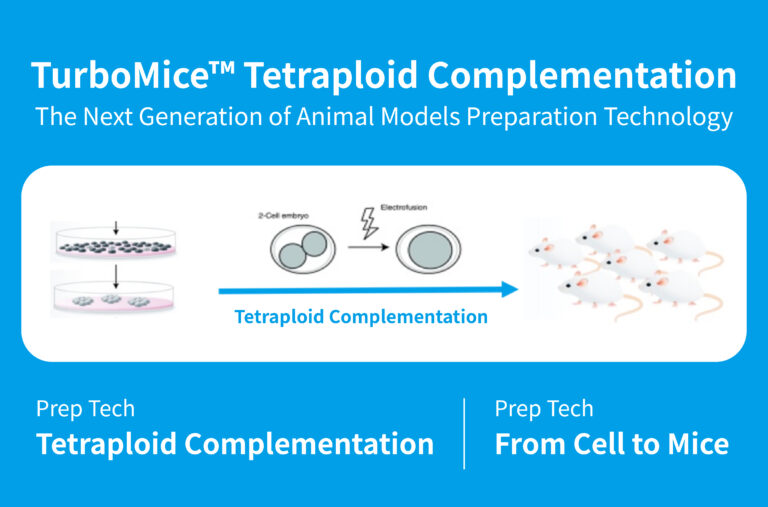
Powered by Tetraploid Complementation Technology (TCT), TurboMice™ bypasses chimerism and intercrossing to deliver 100% ESC-derived, fully homozygous F0 experimental cohorts in just 2 to 4 months.

- 100% ESC-Derived F0 Animals:
During 4N aggregation, electro-fused host embryos (which become tetraploid, 4N) can only form extra-embryonic placenta tissues, while 100% of the fetus develops exclusively from the edited diploid donor ESCs. Every tissue in the F0 pup carries the exact, targeted genotype. - Bypass Breeding & Subfertility Barriers:
If a target gene causes poor mating behavior, subfertility, or reproductive toxicity, traditional breeding collapses. TurboMice™ generates study-ready homozygous cohorts directly from ESC clones without relying on natural reproduction. - Overcome Genetic Linkage Constraints:
Attempting to cross two edited genes located on the same chromosome via standard breeding is nearly impossible due to genetic linkage. TurboMice™ enables multiplex CRISPR/ESC editing on the same chromosome in a single step. - Time & Cost Optimization:
Compressing production timelines by over 50% redirects months of cage housing fees and administrative waiting directly into active in vivo data generation and drug screening.
5. Conclusion
Mouse models remain the gold standard for translational medicine, and embryonic stem cells provide the ultimate canvas for precise genetic engineering. However, the future of biopharmaceutical R&D belongs to platforms that can scale with the speed of modern drug discovery.
By combining the genomic precision of validated ESCs with the transformative power of tetraploid complementation, TurboMice™ bridges the gap between in vitro design and in vivo validation—delivering study-ready, fully homozygous cohorts faster and more reliably than ever before.
Related Products

Related Articles

Frequent Asks
Conditional knockout mice traditionally take a year. Can you really deliver in 4 months?
“Traditional breeding involves generating Flox mice + introducing Cre mice + double-heterozygous mating + homozygous screening; TurboMice™ simultaneously integrates flox and cre elements at the ESC stage and directly produces F0 homozygotes via tetraploid complementation, enabling experimental-ready mice delivery in 4–6 months.”
Can two loci on the same chromosome be floxed together?
Yes. Multi-round editing at the ESC level is not limited by meiotic linkage, and VeloGene has delivered dual/triple-target and over-100-kb fragment editing orders.
Can F0-generation CKO mice be directly used for tissue-specific phenotypic assays?
Yes. F0 cells uniformly carry Cre⁺ and flox⁻/⁻ across the entire body, allowing tissue-specific recombination to be triggered via inducers or endogenous promoters without further breeding.
How are subsequent mouse orders handled?
Cryopreserved ESCs are thawed for a batch delivery in 2 months, maintaining a consistent genetic background.

IP Assurance
At VeloGene, we operate on a strict fee-for-service model. All intellectual property (IP) and materials created for your project are 100% yours. We take every measure to safeguard your IP, ensuring no vectors, ES cells, or mouse lines are retained or resold to third parties. This way, you can focus on your research with complete peace of mind.