


If a person is born with one fewer functional copy of a gene, will they be leaner? In July 2022, the Alnylam team gave an affirmative answer in Nature Communications: based on exome sequencing of 362,679 UK Biobank participants, predicted loss-of-function (pLOF) variants in INHBE were associated with a significantly lower waist-to-hip ratio adjusted for BMI (WHRadjBMI), and this finding was replicated in AMP-T2D-GENES; the most common pLOF variant was validated in vitro to reduce secreted Activin E by approximately 90%, and carriers also showed lower triglycerides, higher HDL, and lower fasting glucose. Around the same time, the multi-ancestry study by Akbari et al. (619,000 individuals) further confirmed that INHBE protein-truncating mutations correspond to favorable fat distribution and a roughly 28% lower risk of type 2 diabetes. Converging evidence from human, monkey, and mouse studies has brought the axis of “how hepatocyte-secreted Activin E directs white adipose tissue toward fat storage or fat burning” into the spotlight. Starting from this genetic discovery, this article follows the molecular mechanism downstream and examines how mouse models can validate all of it.
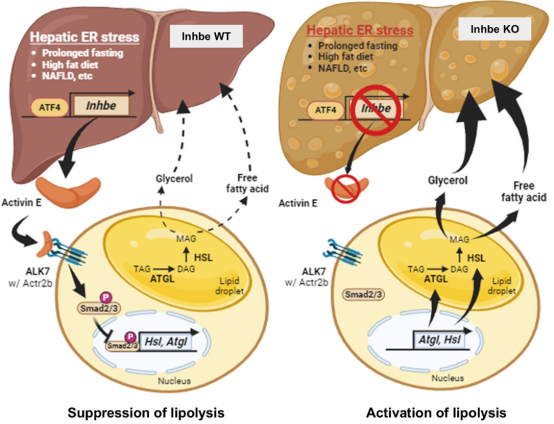
Molecular Mechanism by Which INHBE Regulates Lipid Metabolism
INHBE is a liver-specific gene of the TGF-β superfamily; its product is secreted as Activin E in the form of a βE homodimer, forming a “liver–adipose” endocrine axis: under nutrient excess, fasting, or insulin resistance, fatty acids upregulate hepatic INHBE transcription via PPARα and the endoplasmic reticulum stress–ATF4 pathway; the secreted Activin E reaches white adipose tissue via the bloodstream, binds to the type I receptor ALK7 (ACVR1C) and the type II receptors ActRIIA/IIB on adipocytes, phosphorylates SMAD2/3 and enters the nucleus together with SMAD4, suppresses the lipolytic program dominated by PPARγ/C/EBPα, downregulates lipolytic genes such as ATGL and HSL, and weakens β3-adrenergic receptor–mediated fat mobilization, so that fat is “broken down less and stored more,” thereby driving visceral fat accumulation and insulin resistance in the obese state; under normal physiology, this axis is originally a protective negative feedback that limits excessive fatty acid return to the liver during fasting, whereas pharmacological inhibition of this pathway can reduce visceral fat and preserve lean body mass, but complete knockout will cause fatty acids to be redirected to the liver and produce severe fatty liver; therefore, the therapeutic window lies in “partial inhibition.”
Application Scenarios for INHBE
INHBE application scenarios are mainly concentrated in the metabolic and obesity fields: because human INHBE loss-of-function variants are associated with more favorable fat distribution and lower metabolic disease risk, inhibiting liver-derived Activin E–ALK7 signaling is expected to relieve the suppression of white adipose tissue lipolysis, and be used for fat-loss therapy in overweight/obese individuals, especially those with abdominal obesity, highlighting the differentiated positioning of “selectively reducing visceral fat while preserving lean body mass”; the GalNAc-siRNA drugs ARO-INHBE and WVE-007 have already shown signals in early clinical studies of reducing visceral fat, total fat, and liver fat while maintaining lean body mass, among which ARO-INHBE combined with tirzepatide has also shown the potential to enhance weight loss and fat loss, and WVE-007 is also advancing research in higher-BMI populations, combination therapy, and maintenance treatment after weight loss. In addition, this pathway is also being explored for MASH/metabolic dysfunction-associated steatotic liver disease, type 2 diabetes, insulin resistance, and cardiometabolic risk management, but whether long-term inhibition will aggravate fatty liver due to the transfer of fatty acids to the liver remains the key question determining its clinical scope of application and safety window.
Humanized INHBE Mice
From target validation to IND filing, humanized animal models are an unavoidable step, especially on the INHBE track. siRNAs/ASOs targeting human INHBE generally cannot effectively recognize mouse Inhbe, the coding region homology of INHBE between human and mouse is limited, and antibodies often do not cross-react either, so the true pharmacological effect cannot be measured in wild-type mice. The current mainstream approach in the market is knock-in replacement rather than random transgenesis: replacing the coding exons of mouse Inhbe with the human sequence while disrupting the endogenous mouse gene, so that only human INHBE is expressed; the difference mainly lies in “whose regulatory elements are retained.” VeloGene Biotechnology can customize humanized mice rapidly, precisely, and at scale according to customer needs through its TurboMice™ high-efficiency tetraploid complementation technology platform; investigators are welcome to inquire.
References
- Deaton AM, Dubey A, Ward LD, Dornbos P, Flannick J, Yee E, Ticau S, Noetzli L, Parker MM, Hoffing RA, … Fitzgerald K, Vaishnaw AK, Nioi P; AMP-T2D-GENES Consortium. Rare loss of function variants in the hepatokine gene INHBE protect from abdominal obesity. Nature Communications. 2022;13(1):4319. DOI: 10.1038/s41467-022-31757-8. PMID: 35896531; PMCID: PMC9329324.
- Akbari P, Sosina OA, Bovijn J, Landheer K, Nielsen JB, Kim M, Aykul S, De T, Haas ME, Hindy G, … Lotta LA; Regeneron Genetics Center. Multiancestry exome sequencing reveals INHBE mutations associated with favorable fat distribution and protection from diabetes. Nature Communications. 2022;13(1):4844. DOI: 10.1038/s41467-022-32398-7. PMID: 35999217; PMCID: PMC9399235.
- ADAM R C, PRYCE D S, LEE J S, et al. Activin E–ACVR1C cross talk controls energy storage via suppression of adipose lipolysis in mice[J]. Proceedings of the National Academy of Sciences of the United States of America, 2023, 120(32): e2309967120. DOI: 10.1073/pnas.2309967120. PMID: 37523551.
- PARK S Y, CHO Y, SON S M, et al. Activin E is a new guardian protecting against hepatic steatosis via inhibiting lipolysis in white adipose tissue[J]. Experimental & Molecular Medicine, 2025, 57(2): 466-477. DOI: 10.1038/s12276-025-01403-6. PMID: 39948368; PMCID: PMC11873131.
- ONGARO L, BERNARD D J. Activin Actions in Adipocytes[J]. The Journal of Clinical Endocrinology & Metabolism, 2025, 110(7): 1803-1810. DOI: 10.1210/clinem/dgaf233. PMID: 40208114; PMCID: PMC12192441.
- YANG, ZHAO, MA. Activin E, Body Fat Distribution, and Insulin Resistance: Human Genetics, Liver–Adipose Communication, and Translational Perspectives[J]. Frontiers in Endocrinology, 2026, 17: 2005408. DOI: 10.3389/fendo.2026.2005408.