


1. What are ADC drugs?
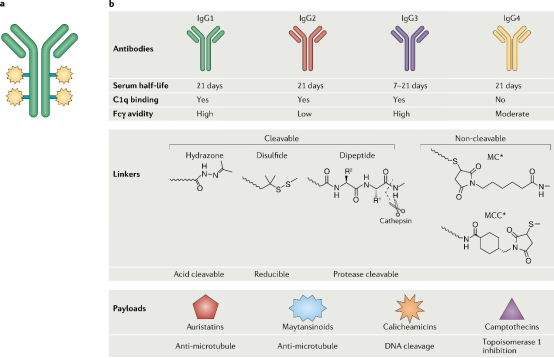
Antibody-drug conjugates (ADCs) consist of an antibody, a linker, and a cytotoxic drug, and achieve tumor killing through antigen-targeted binding and intracellular drug release. In recent years, with the success of blockbuster drugs such as Enhertu (T-DXd) and T-DM1, ADCs have become one of the fastest-growing and most fiercely competitive fields in oncology.
2. The mechanism of ADC drugs
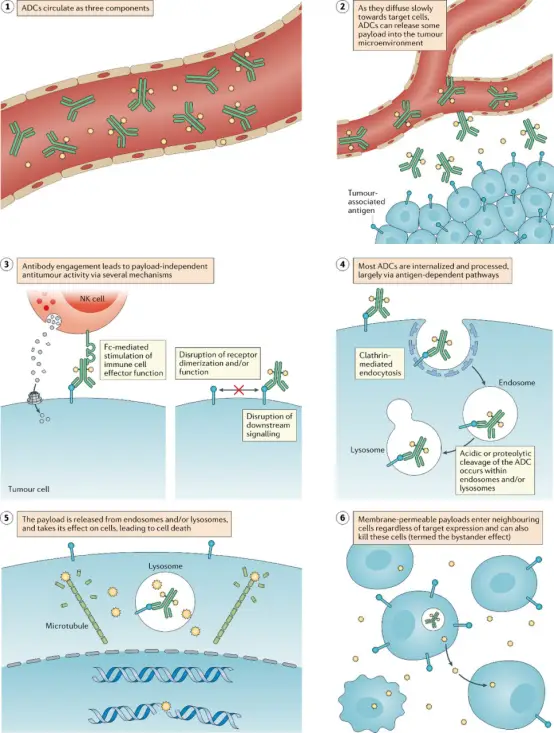
The mechanism of action of ADCs is a multi-step cascade, centered on “targeted delivery, intracellular release”:
- Targeted binding: The antibody portion of the ADC specifically recognizes and binds the target antigen on the surface of tumor cells.
- Internalization and trafficking: The antigen–ADC complex enters the cell through receptor-mediated endocytosis, forms an endosome, and is ultimately transported to the lysosome.
- Drug release: The linker is enzymatically cleaved or chemically degraded in the lysosome (or in the tumor microenvironment), releasing the cytotoxic drug.
- Cytotoxic killing: The released drug acts on intracellular targets (such as DNA or tubulin), inducing tumor cell apoptosis.
- Bystander effect: Some highly hydrophobic toxins can cross the cell membrane and diffuse to surrounding antigen-negative or antigen-low tumor cells, exerting a broader killing effect.
3. Development challenges of ADC drugs
Although the principle appears straightforward, ADC development faces extremely high technical barriers and is described as “complexity within complexity”:
- Difficult target selection: An ideal target should be highly expressed in tumor tissue, expressed at low levels in normal tissue, and possess efficient internalization capacity. However, many potential targets have “on-target toxicity” (they are also expressed in normal tissues) or low internalization efficiency, resulting in a very narrow therapeutic window.
- The “golden triangle” is hard to balance: The optimized combination of antibody, linker, and payload (such as the drug-to-antibody ratio, DAR; linker stability; hydrophobicity) requires fine balance, and a slight misstep can lead to excessive toxicity or insufficient efficacy.
- Off-target and systemic toxicity: Premature cleavage of the linker in the blood causes systemic toxicity; binding of the Fc region to Fc receptors (FcγR) on the surface of immune cells may trigger uptake by non-target cells (such as thrombocytopenia and interstitial lung disease).
- Drug resistance: Tumor cells can develop resistance through mechanisms such as antigen downregulation, internalization defects, and upregulation of drug efflux pumps.
- Difficulty predicting clinical translation: Owing to species differences (different targets, immune mechanisms, and metabolic enzymes), conventional mouse models often cannot accurately predict human pharmacokinetics (PK), pharmacodynamics (PD), and toxicity responses, leading to high clinical failure rates.
4. ADC preclinical studies and the application of gene-edited mice
Gene-edited mouse technology spans the entire chain of ADC preclinical research. Its core value lies in reproducing human targets, immune mechanisms, and the metabolic environment, and in solving the “species bias” problem of conventional models.
4.1 Target validation and discovery
Confirming “whether this antigen can really carry an ADC” is the first step.
- Target-humanized knock-in (KI) models: The mouse homologous gene is replaced with the human target sequence, while the endogenous physiological expression pattern is retained.
- CRISPR antigen-positive/negative paired models: By knocking out the target gene, these models directly demonstrate that “efficacy comes from antigen-mediated internalization rather than passive accumulation.”
4.2 Antibody discovery and optimization
- Fully human antibody platform mice: Through gene editing, the variable regions of mouse immunoglobulin are replaced with human sequences while the intact mouse immune system is retained, enabling direct screening of high-affinity, fully human therapeutic antibodies by immunization and reducing immunogenicity risk.
- Bispecific ADC development platform: Gene editing is used to construct common light chain mice, fundamentally solving the light/heavy chain mispairing problem of bispecific antibodies; this platform has successfully produced bispecific ADC candidate molecules such as TROP2×EGFR.
4.3 Efficacy evaluation
- CRISPR isogenic models: Antigen-positive and antigen-negative tumor cells are constructed in the same genetic background; this is the “gold standard” for validating target specificity and the bystander effect.
- Humanized immune system (HIS) mice: Human hematopoietic stem cells (CD34+) or PBMC are transplanted into immunodeficient mice to reconstitute the human immune system, and are used to evaluate Fc-dependent antibody-dependent cell-mediated cytotoxicity (ADCC) and phagocytosis (ADCP), as well as the combination of ADCs with immune checkpoint inhibitors.
4.4 PK/PD and linker stability
- FcRn-humanized mice: Mouse FcRn differs from human FcRn in its IgG-binding properties, which causes bias in ADC half-life prediction. Humanized FcRn models can improve the accuracy of half-life prediction to a level highly correlated with clinical data (r²=0.95).
- FcγR-humanized mice: Human IgG cross-reacts poorly with mouse FcγR, and conventional mice mask the effector functions or toxicity of Fc-engineered antibodies. Fully human FcγR knock-in models can correctly evaluate Fc variants and predict risks such as platelet clearance and hepatotoxicity.
4.5 Safety evaluation
- On-target toxicity prediction: Target-humanized models can expose in advance the toxicity risk arising from target expression in normal tissues.
- Off-target/Fc-mediated toxicity: hFcγR models can reproduce FcγR-driven non-target cell uptake toxicity (such as the interstitial lung disease of T-DXd and the thrombocytopenia of T-DM1), which wild-type mice and non-human primates (NHP) find difficult to model.
- Immune-related toxicity: HIS models are used to evaluate adverse reactions caused by immune activation.
4.6 Resistance mechanisms and biomarkers
Patient-derived xenograft (PDX) models are used for continuous dosing to induce resistance, combined with gene editing (such as CRISPR screening) to reverse-validate resistance genes, providing precise biomarkers for patient stratification and combination therapy in clinical trials.
5. Summary
ADC (antibody-drug conjugate) consists of an antibody, a linker, and a cytotoxic drug, and achieves tumor killing through antigen-targeted binding and intracellular drug release. The development of this class of drugs faces challenges such as limited target selection, a narrow therapeutic window, off-target toxicity, drug resistance, and difficulty in predicting clinical translation. Gene-edited mouse models, through target-humanized knock-in, CRISPR gene knockout, and humanization of immune/metabolic genes, support target validation, fully human antibody discovery, efficacy assessment, PK/PD analysis, and safety prediction in preclinical research, effectively reducing the data bias caused by species differences. This technology has become a key tool in the ADC R&D workflow; in the future, combined with multi-gene composite editing and PDX/organoid models, it will further improve clinical translation efficiency.
References
Drago, J., Modi, S., & Chandarlapaty, S. (2021). Unlocking the potential of antibody-drug conjugates for cancer therapy. Nature Reviews Clinical Oncology, 18(6), 327–344. https://doi.org/10.1038/s41571-021-00470-8
Dumontet, C., Reichert, J. M., Senter, P. D., Lambert, J. M., & Beck, A. (2023). Antibody-drug conjugates come of age in oncology. Nature Reviews Drug Discovery, 22(8), 641–661. https://doi.org/10.1038/s41573-023-00709-2
Bender, M. J., Lee, S. T., Sullivan, T. B., & et al. (2019). Antibody-Drug Conjugate-Based Therapeutics: State of the Science. Journal of the National Cancer Institute. https://doi.org/10.1093/jnci/djz035