


BCMA (B cell maturation antigen, CD269) is encoded by TNFRSF17. What happens when its signaling is weakened? Genetics has already given the answer: germline loss-of-function variants in TNFRSF17 can cause impaired antibody production. Carriers present with hypogammaglobulinemia and recurrent infections, and some fit the phenotype of common variable immunodeficiency (CVID). Reported pathogenic sites include missense mutations such as Cys85Ser and Cys104Arg/Tyr, which disrupt disulfide bonds, impair ligand binding, and deprive plasma cells of their survival signal.
Seen from the opposite direction, multiple myeloma cells express BCMA at high abundance on their surface and rely on APRIL/BCMA signaling to sustain their own survival and drug resistance; in the bone marrow microenvironment, APRIL/BAFF acting through BCMA determine whether plasma cells survive or undergo apoptosis.
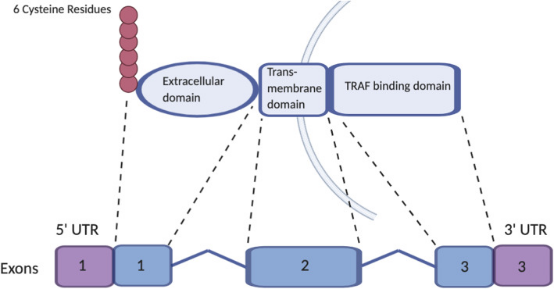
Molecular Mechanism by Which BCMA Regulates Plasma Cell Survival
The BCMA gene is located at 16p13.13, spans approximately 3.8 kb, and contains 3 exons; its product is a type I transmembrane glycoprotein that lacks a death domain. BCMA expression rises with B cell differentiation, peaks at the plasmablast and plasma cell stages, is almost absent in naive and memory B cells, and is highly expressed in myeloma cells.
The ligands of BCMA are BAFF (BLyS) and APRIL, with APRIL showing roughly 1–2 orders of magnitude higher affinity. Ligand binding induces BCMA trimerization and recruits TRAF2/3/5/6 (TRAF1 binds indirectly through TRAF2), activating both the canonical and non-canonical NF-κB pathways: NIK accumulates, IKKα is phosphorylated, p100 is processed into p52, and p52/RelB enters the nucleus, upregulating anti-apoptotic genes such as Bcl-xL, Bcl-2 and Mcl-1 and sustaining the survival of long-lived plasma cells in the bone marrow. BCMA simultaneously activates JNK and p38 MAPK, which jointly regulate proliferation and differentiation.
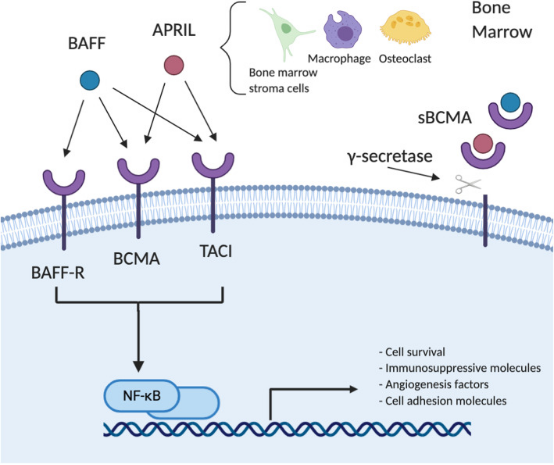
The three receptors have clearly divided roles: BAFF-R maintains naive B cell survival, TACI governs class switching, and BCMA is dedicated to plasma cell survival; together they form the regulatory network of humoral immunity. Membrane BCMA is cleaved by γ-secretase to release soluble sBCMA, which both reflects tumor burden dynamics and serves as an antigen sink that consumes anti-BCMA drugs and weakens their binding to membrane BCMA.
Under physiological conditions, this axis safeguards long-term humoral immune memory; in the myeloma state, it is hijacked by the tumor as an engine of survival and drug resistance. Targeting this pathway can clear malignant plasma cells, whereas complete blockade suppresses normal antibodies and raises infection risk. The clinical question is the balance between “deep tumor clearance” and “preserved humoral immunity.”
BCMA-Related Pipeline
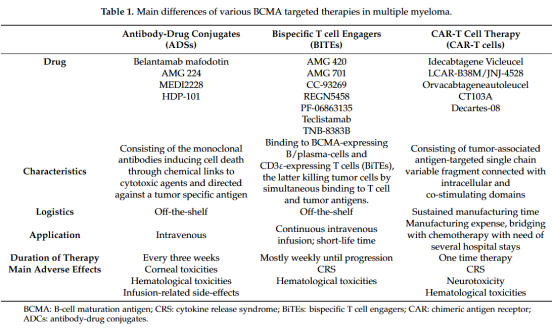
BCMA applications concentrate in hematologic malignancies, with the core indication being relapsed/refractory multiple myeloma (RRMM). The rationale rests on two points: myeloma cells depend on high BCMA expression, while normal tissues other than plasma cells express it almost not at all, creating a clear expression gap.
Three approved modalities: CAR-T (ide-cel/Abecma, cilta-cel/Carvykti), bispecific T cell engagers (teclistamab, elranatamab and others, targeting BCMA×CD3), and ADC (belantamab mafodotin; accelerated approval in 2020, withdrawn from the US market after DREAMM-3 missed its primary endpoint, then re-approved in 2025 on the basis of DREAMM-7 in combination with bortezomib plus dexamethasone). In terms of efficacy, anti-BCMA therapies achieve overall response rates of approximately 70%–100% in heavily pretreated RRMM.
Major toxicities include cytokine release syndrome (CRS), immune effector cell-associated neurotoxicity syndrome (ICANS), cytopenias, and infections; a minority of cases develop hemophagocytic lymphohistiocytosis (HLH).
The main mechanism of resistance is antigen escape. Biallelic loss at the TNFRSF17 locus leads to BCMA-negative relapse; missense mutations or in-frame deletions in the extracellular domain (such as Arg27Pro, Pro34 del, Ser30 del) preserve APRIL binding capacity while evading antibody recognition. Three countermeasures are being pursued: γ-secretase inhibitors to lower sBCMA, dual-target CAR-T, and sequential or combination regimens directed at different BCMA epitopes.
This pathway is also being explored in autoimmune disease. AAV-delivered sBCMA acting as a decoy competes for BAFF/APRIL binding and, in SLE mouse models, suppresses autoreactive B cells and reduces autoantibodies. Whether long-term inhibition increases infection because antibody levels remain persistently low is still the key question determining clinical scope and safety window.
Humanized BCMA Mice
Anti-human BCMA antibodies, CAR-T, and bispecific T cell engagers mostly do not recognize mouse Bcma. Wild-type mice cannot reflect the true pharmacology of these drugs.
The mainstream approach is knock-in replacement rather than random transgenesis. The construction strategy is to replace the coding exons of mouse Tnfrsf17 with the human sequence while simultaneously disrupting the endogenous mouse gene, so that the model expresses only human BCMA. Designs differ mainly in which set of regulatory elements is retained. Common designs keep the endogenous mouse promoter and 5′UTR/3′UTR and replace only the extracellular domain or the entire coding region, so that hBCMA expression stays close to physiological levels.
VeloGene can customize humanized BCMA mice on demand. The TurboMice™ tetraploid complementation platform aggregates embryonic stem cells with tetraploid embryos, obtaining homozygotes directly from targeted ESCs and bypassing conventional breeding and screening, with delivery times as short as 3–5 months. Investigators are welcome to inquire.
References
- KAYAOGLU B, CETIN G K, SIK S, et al. BCMA deficiency as a novel cause of common variable immunodeficiency[J]. Journal of Clinical Immunology, 2025, 45(Suppl 1): CIS2025abstract.111. DOI: 10.70962/CIS2025ABSTRACT.111.
- KLEBER M, NTANASIS-STATHOPOULOS I, TERPOS E. BCMA in multiple myeloma—A promising key to therapy[J]. Journal of Clinical Medicine, 2021, 10(18): 4088. DOI: 10.3390/jcm10184088.
- ZHENG H, XIAN H, ZHANG W, et al. BCMA-targeted therapies for multiple myeloma: latest updates from 2024 ASH annual meeting[J]. Journal of Hematology & Oncology, 2025, 18: 1675. DOI: 10.1186/s13045-025-01675-5.
- LEE H, AHN S, MAITY R, et al. Mechanisms of antigen escape from BCMA- or GPRC5D-targeted immunotherapies in multiple myeloma[J]. Nature Medicine, 2023, 29(9): 2295-2306. DOI: 10.1038/s41591-023-02491-5.
- Yu B, Jiang T, Liu D. BCMA-targeted immunotherapy for multiple myeloma. J Hematol Oncol. 2020 Sep 17;13(1):125. doi: 10.1186/s13045-020-00962-7. PMID: 32943087; PMCID: PMC7499842.