




What Is Sickle Cell Disease?
Sickle Cell Disease (SCD) is an autosomal recessive disorder characterized by structural abnormalities in hemoglobin molecules. The core pathogenic driver is a point mutation in the HBB gene encoding hemoglobin β-globin. Under hypoxic conditions, mutant hemoglobin abnormally polymerizes, distorting red blood cells from normal biconcave discs into rigid sickle-shaped erythrocytes. These deformed cells readily occlude microvessels, triggering tissue ischemia, pain and multi-organ damage. In addition, sickled red blood cells undergo premature destruction, resulting in chronic anemia that may be life-threatening in severe cases.
SCD affects millions of people globally, with high prevalence across Africa and Mediterranean regions. HbSS is the most common subtype, accounting for approximately 70% of cases in populations of African descent. Typical clinical manifestations include recurrent pain crises, chronic anemia, elevated infection risk and progressive dysfunction across multiple organ systems.
Pathogenesis
Sickle Cell Disease HbSS subtype arises from a point mutation at chromosomal locus 11p15.5 within the HBB gene, most frequently present in homozygous state for the βS allele (HbSS). This mutation replaces the hydrophilic glutamic acid at the 6th position of the β-globin chain with hydrophobic valine, generating the abnormal hemoglobin tetramer HbS (α2βS2). The βS allele may also co-inherit with other β-globin variants (βC, βD, βO, βE) or β-thalassemia alleles to form compound heterozygous genotypes such as HbSC and HbS/β-thalassemia, which trigger disease via analogous molecular and cellular mechanisms.
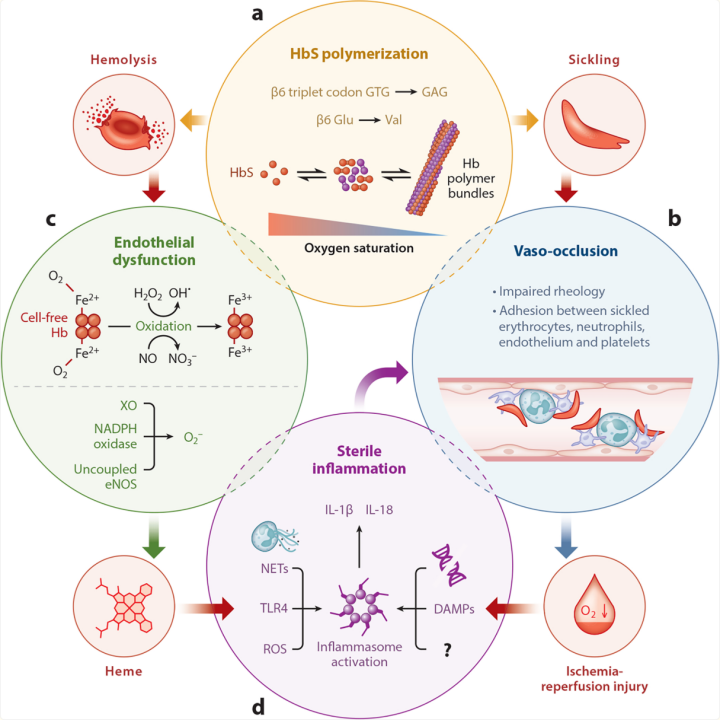
Under low-oxygen conditions, hydrophobic HbS molecules readily self-assemble into insoluble fibrous polymers. These polymers form rigid intracellular networks that physically twist erythrocytes into the characteristic sickle morphology.
Sickled red blood cells lose normal deformability and become trapped within narrow capillaries, obstructing microcirculation and causing regional tissue ischemia and hypoxia. Meanwhile, sickled erythrocytes exhibit compromised membrane stability and are rapidly recognized and cleared by macrophages in the spleen and liver, leading to chronic hemolytic anemia.
Massive free hemoglobin is released during hemolysis, which binds and depletes nitric oxide, impairing vasodilatory function, inducing endothelial injury and vasoconstriction. Hemolysis also liberates free iron ions that catalyze reactive oxygen species (ROS) production, driving oxidative stress and activating endothelial cells and platelets to initiate sterile inflammatory cascades. Inflammasomes are subsequently activated to secrete pro-inflammatory mediators IL-1β and IL-18, further exacerbating vascular damage and hemolysis. Repeated microvascular stasis and reperfusion trigger ischemia-reperfusion injury; restored blood flow generates abundant oxygen free radicals that amplify cellular and tissue damage.
Preclinical Mouse Models for SCD Research
Humanized HbS Mice
The endogenous murine globin genes (Hba, Hbb) are replaced with human α-globin gene clusters and gene fragments carrying the βS (Glu6Val) allele. This strain recapitulates human hemoglobin composition and stably exhibits core SCD phenotypes including red blood cell sickling, chronic hemolytic anemia, microvascular occlusion and systemic multi-organ inflammation. It represents the gold-standard preclinical model for investigating sickle vasculopathy and evaluating novel SCD therapeutics.
VeloGene Biotechnology Accelerates SCD Gene Therapy R&D
Gene therapy offers transformative opportunities for rare hereditary blood disorders, yet preclinical mechanistic research and therapeutic efficacy validation are entirely dependent on standardized, well-characterized animal models.
Powered by our proprietary TurboMice™ technology, VeloGene Biotechnology resolves two longstanding technical bottlenecks of traditional transgenic strain construction: prolonged breeding cycles and low success rates for complex multi-locus genetic modifications. The platform supports precise editing of nearly any target genomic locus and generates fully homozygous gene-edited mouse lines directly from embryonic stem cells in as little as 2 months.
VeloGene Biotechnology provides custom humanized HbS sickle cell disease mouse models tailored to experimental requirements. Academic and industrial investigators are welcome to contact our technical team for project consultations!