




Induced pluripotent stem cells (iPSCs) are generated by reprogramming differentiated somatic cells back into pluripotent stem cells. They open new avenues for drug development and supply valuable cellular resources for cell‑replacement therapy.
Pluripotent stem cells (PSCs) are mainly derived from the inner‑cell mass (ICM of blastocysts) and pre‑gastrulation embryos. Capable of differentiating into all tissue types within an organism, they represent cells with the highest developmental potential in modern cell‑culture technology. Nevertheless, reprogramming somatic cells toward pluripotency requires thorough epigenetic remodelling, which was once considered nearly unachievable.
The Yamanaka four‑factor set — Oct4, Sox2, Klf4 and c‑Myc (abbreviated OSKM) — drives pluripotency induction within the embryonic inner‑cell mass (ICM) and also regulates subsequent cell‑differentiation events. Among them, Oct4, Sox2 and Klf4 (OSK) act as pioneer transcription factors that bind silent chromatin; this pioneer‑factor activity is harnessed in iPSC technology to restore pluripotency in somatic cells in vitro.
Loss of Oct4 abolishes pluripotency in somatic cells. Down‑regulation of Oct4 does not trigger immediate collapse of pluripotency but stabilizes the pluripotency regulatory network, indicating additional critical roles for Oct4 during cellular differentiation. Though Oct4 was once deemed indispensable for iPSC generation, activation of endogenous Sox2 marks the completion of pluripotency induction. Furthermore, exogenous Oct4 supplementation reduces the developmental potential of OSKM‑ and SKM‑derived iPSCs. These observations underscore the importance of deeper mechanistic studies on Oct4 to advance iPSC technology.
During mouse embryonic development, cell fate is largely determined at the 4‑cell stage. High Sox2 expression together with sustained Sox2‑Oct4 binding drives inner‑cell‑mass formation. Mice and humans differ in Oct4‑dependency for pluripotency establishment: Oct4‑knockout mouse blastocysts can still form Nanog‑positive inner‑cell‑mass tissue, whereas human OCT4‑knockout blastocysts cannot. Therefore, developing effective new strategies for pluripotent‑stem‑cell induction in non‑rodent species, especially humans, represents an urgent unmet research need.
A collaborative work led by the Hans R. Schöler laboratory at the Max Planck Institute, together with Dr. Guangming Wu’s team at MingCeler Biotech, was published in the top journal Cell Stem Cell. The paper is titled Highly cooperative chimeric super‑SOX induces naive pluripotency across species. Dr. Guangming Wu from MingCeler Biotech participated in this study and performed detailed analytical work.
Inside pluripotent stem cells, Oct4 and Sox2 work cooperatively to regulate numerous target genes. Their synergy arises from protein‑protein interactions at DNA‑binding domains plus DNA conformational remodelling. At early reprogramming stages when native chromatin sites remain inaccessible, Oct4 and Sox2 often bind DNA independently. When both factors occupy the same locus, chromatin opening probability rises substantially. In particular, the Sox2‑Oct4 heterodimer bound to canonical HoxB1‑like Sox‑Oct motifs is critical for pluripotency induction and maintenance.
Beyond Sox2, Sox17 can also cooperate with Oct4; however, Sox17 preferentially binds compact Sox‑Oct motifs to specify primitive endoderm and germ‑cell fate. Single‑amino‑acid substitution (Sox17E57K) shifts Sox17 binding preference toward canonical Sox‑Oct sites, converting Sox17 into a pluripotency inducer. Moreover, the large, potent C‑terminal transactivation domain of Sox17 can augment Sox2 function.
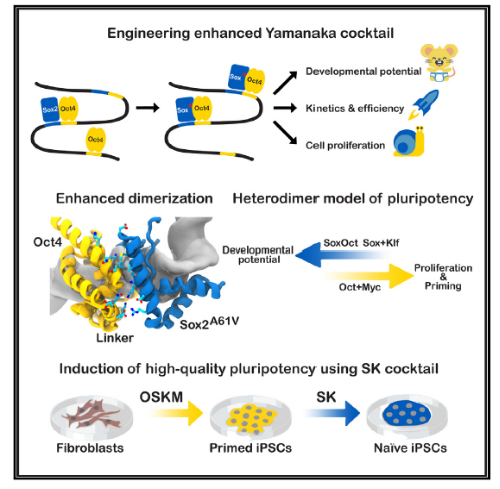
In this study, the authors showed that replacing Sox2 with Sox17E57K within reprogramming cocktails restores iPSC‑generating capacity for Oct4 mutant backgrounds. Next, they combinatorially shuffled structural modules from Sox2 and Sox17, mapped the functional segments responsible for this striking phenotype, and constructed a chimeric super‑SOX factor termed Sox2‑17. The group further validated that Sox2‑17 markedly boosts iPSC generation across five species: mouse, human, rhesus macaque, cattle and pig.
Additionally, amino‑acid substitution (A61V) at the Sox2‑Oct4 protein‑protein interface stabilizes Sox2‑Oct4 heterodimer assembly on DNA and enhances functional output. This modification enables generation of high‑quality OSKM iPSCs capable of supporting development of fully iPSC‑derived healthy mice. The iPSC‑derived mice were provided by VeloGene Biotechnology(MingCeler Biotech).
Tetraploid‑Complementation Technology
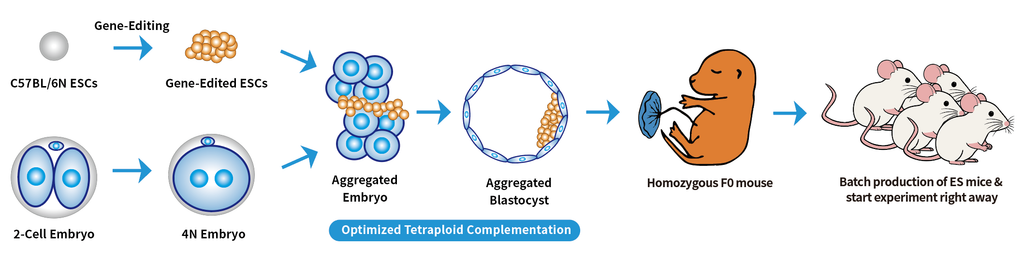
Normal diploid mouse 2‑cell‑stage embryos can be electrofused to generate tetraploid embryos. Tetraploid embryos carry developmental defects and can only form extra‑embryonic tissues such as placenta and umbilical cord. Embryonic stem cells (ESCs) can differentiate into all fetal cell lineages yet fail to produce placental tissue due to spontaneous‑differentiation constraints. When ESCs are aggregated with tetraploid embryos to form reconstructed blastocysts, tetraploid cells exclusively contribute to extra‑embryonic structures, while the entire foetus originates purely from diploid embryonic stem cells. This experimental system is known as tetraploid complementation.
Nowadays, CRISPR/Cas9 and other genome‑editing tools enable precise manipulation of embryonic‑stem‑cell genomes: gene knock‑in, knock‑out, point mutation and humanization. Combined with tetraploid complementation, homozygous experimental mice carrying desired genotypes can be directly produced from edited stem‑cell clones in batches, eliminating substantial time, labour and material costs associated with conventional breeding and screening workflows.
Although tetraploid complementation was invented more than two decades ago, overall success rates have remained persistently low, and the technique is only mastered by a small number of top laboratories worldwide. Reported live‑birth rates in most publications range merely from 1 %‑5 %, restricting its use purely to academic research. Gene‑edited mice represent essential tools for molecular mouse biology, innovative‑drug and vaccine development, generating huge global demand for industrial‑scale high‑efficiency tetraploid‑complementation services.
Dr. Guangming Wu’s laboratory has developed proprietary high‑efficiency tetraploid‑complementation workflows that elevate mouse live‑birth rates to 30‑60 %, removing key bottlenecks preventing industrial translation. Genetically‑modified target mice can be mass‑produced directly from mouse embryonic stem cells, bypassing time‑consuming conventional breeding and screening and drastically shortening model‑generation timelines.
Industrial deployment of this technology enables custom generation of diverse genetically‑modified model mice with superior speed, efficiency and quality for global research institutions, universities, hospitals and pharmaceutical enterprises engaged in life‑science research. Our globally‑competitive model‑production timelines strongly support vaccine development, new‑drug discovery, precision‑medicine research and emergency‑response scientific projects. It fulfils urgent demands for rapid generation of complex disease animal models and promises to substantially advance life‑science research.
References
[1] MacCarthy CM, Wu G, Malik V, Menuchin‑Lasowski Y, Velychko T, Keshet G, Fan R, Bedzhov I, Church GM, Jauch R, Cojocaru V, Schöler HR, Velychko S. Highly cooperative chimeric super‑SOX induces naive pluripotency across species. Cell Stem Cell. 2024 Jan 4;31(1):127‑147.e9. doi:10.1016/j.stem.2023.11.010. IF:19.8, Q1. Epub 2023 Dec 22. PMID: 38141611.
[2] Tokoro M, Fukunaga N, Yamanaka K, Itoi F, Terashita Y, Kamada Y, Asada Y, Wakayama S, Wakayama T. A Simple Method for Transportation of Mouse Embryos Using Microtubes and a Warm Box. PLoS One. 2015;10(9):e0138854. doi:10.1371/journal.pone.0138854
[3] Sarvari A, Naderi MM, Sadeghi MR, Akhondi MM. A technique for facile and precise transfer of mouse embryos. Avicenna J Med Biotechnol. 2013;5(1):62‑65.
[4] Boland MJ, Hazen JL, Nazor KR, Rodriguez A, Gifford W, Martin G, Kupriyanov S, Baldwin KK. Adult mice generated from induced pluripotent stem cells. Nature. 2009;461(7260):91‑94. doi:10.1038/nature08310 [5] Zhao X‑Y, Li W, Lv Z, Liu L, Tong M, Hai T, Hao J, Guo C‑L, Ma Q, Wang L, Zeng F, Zhou Q. iPS cells produce viable mice through tetraploid complementation. Nature. 2009;461(7260):86‑90. doi:10.1038/nature08267