




In recent years, gene‑editing and AAV‑based gene therapies have frequently made headlines, hailed as beacons of hope for curing genetic diseases. What many overlook, however, is that before these cutting‑edge therapies advance to human trials, they must repeatedly pass a “hidden checkpoint”: pre‑clinical animal studies. Seemingly routine, these studies represent the final biological safeguard protecting human safety.
What Stands Between the Lab Bench and Human Subjects?
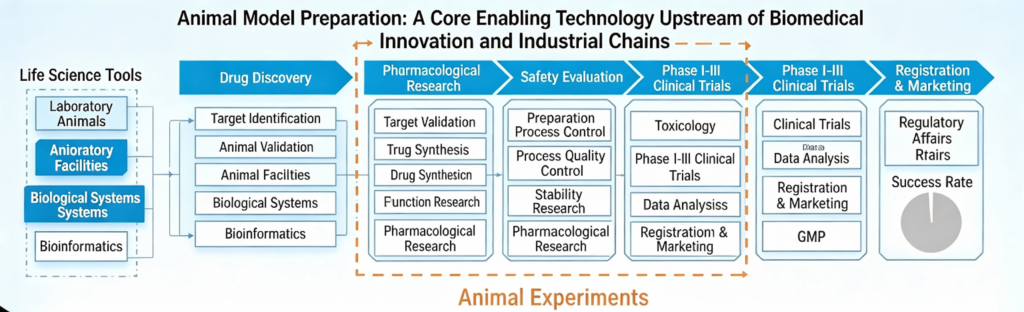
New‑drug development resembles a precision relay race. Scientists first validate hypotheses using cells in petri dishes, yet these systems are far removed from living human organisms. Cell cultures lack immune systems and blood circulation and cannot recapitulate drug metabolism across diverse organs.
Accordingly, before entering hospitals and recruiting human volunteers, therapeutics must complete a rigorous battery of animal tests. This is not only a mandatory requirement set by global drug‑regulatory authorities but also a scientific necessity — especially for AAV gene therapies, which demand extremely precise dose control.
Exactly What Do Animal Studies Evaluate?
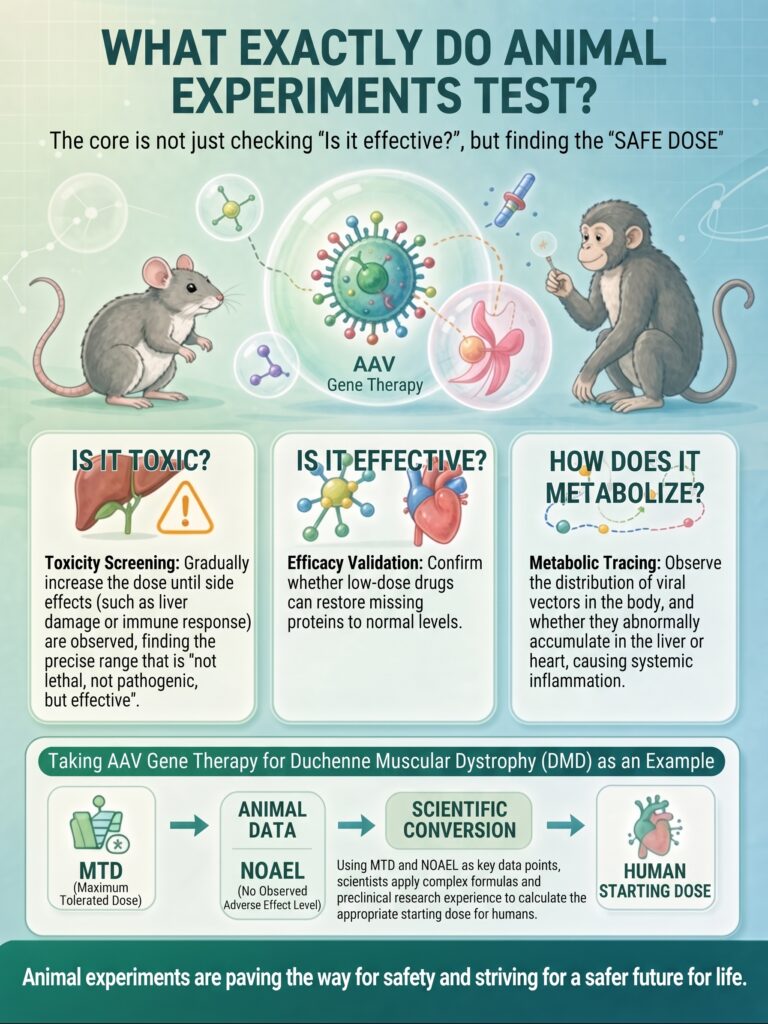
Many assume animal experiments merely test whether a drug works. In reality, identifying safe dosage ranges constitutes their core mission.
Take AAV gene therapies for Duchenne Muscular Dystrophy (DMD) as an example (hyperlink: Overcoming Bottlenecks in DMD Clinical Translation: VeloGene Biotechnology Launches DMD Humanized Mice). Scientists conduct multiple rounds of testing in mice and non‑human primates (e.g., monkeys):
- ✅ Toxicity profiling: Dose escalation until adverse effects (such as liver injury or immune reactions) emerge, to pinpoint a therapeutic window that delivers efficacy without causing severe harm.
- ✅ Pharmacodynamic validation: Verify whether low‑dose administration restores physiological levels of the missing target protein.
- ✅ Metabolic biodistribution tracking: Monitor in‑vivo viral‑vector distribution, checking for aberrant accumulation in organs such as the liver or heart that could trigger systemic inflammation.
This process defines the Maximum Tolerated Dose (MTD) and No‑Observed‑Adverse‑Effect Level (NOAEL). Only with these critical datasets can researchers apply computational formulas to calculate safe starting doses for human participants.
Why Cannot Computer Simulations Fully Replace Animal Studies?
Advancements in AI and organoid technology raise a natural question: can computer modelling substitute animal experiments? The short answer is not yet.
The core reason lies in biological complexity.
Once AAV vectors enter living organisms, they trigger highly intricate humoral and cellular immune responses — including complement activation, cytokine storms and even acute respiratory distress syndrome. Such events cannot be fully predicted by current in‑silico models. Notably, certain neurological injuries or immune adverse events observed in large‑animal models such as monkeys may be entirely absent in mice, yet these risks directly determine human safety.
Simply put, animal studies anticipate severe life‑threatening risks at minimal biological cost.
Regulatory Red Line: From Optional to Mandatory
Previously, some investigator‑initiated trials (IITs) operated under relatively flexible approval workflows. Following China’s implementation of the Regulations on the Clinical Research and Transformation Application of New Biomedical Technologies, regulatory oversight has been significantly strengthened.
The new rules explicitly mandate robust pre‑clinical animal data even for non‑commercial clinical studies. No matter how innovative the technology or substantial the funding, credible animal‑toxicology reports are required to pass ethical‑review thresholds.
Closing: Respect the Laws of Science
Scientific exploration is inherently filled with unknowns, yet medical progress cannot rest on luck. Though time‑consuming and labor‑intensive, pre‑clinical animal work delivers safety‑window datasets that no advanced‑technology alternative can currently replicate.
For gene‑therapy development, honouring dose boundaries defined by animal studies means honouring future patients. Only by completing this critical step thoroughly can the promise of curative therapies for genetic diseases safely become reality.