



User: Doctor Ming, I’ve been reading about gene-edited mice lately and keep coming across “ROSA26 mice.” What exactly are they? And why do so many studies prefer the ROSA26 locus?
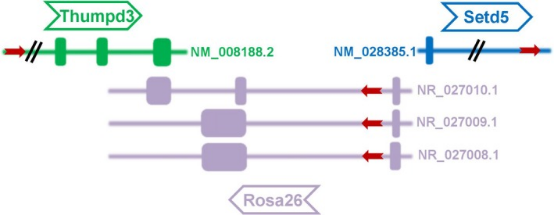
Dr. Ming: ROSA26 mice generally refer to mice in which the genomic Gt(ROSA)26Sor locus has been genetically modified. ROSA26 is an endogenous locus on mouse chromosome 6, first discovered in 1991 through a gene-trap experiment. It primarily transcribes non-coding RNA and does not encode any important protein, so inserting foreign DNA at this locus generally does not noticeably affect normal development, survival, or reproduction in mice. It is therefore a commonly used safe harbor locus in gene editing.
Scientists commonly use homologous recombination or CRISPR/Cas9 to insert reporter genes, Cre recombinases, or target genes site-specifically into the ROSA26 locus, thereby establishing different types of gene-edited mouse models.
1. What is the ROSA26 locus?
ROSA26 (full name Gt(ROSA)26Sor) is an endogenous locus located on mouse chromosome 6. It was named after the 26th clone identified in a gene-trap screen of mouse embryonic stem cells conducted by Friedrich and Soriano in 1991 (ROSA stands for “Reverse Orientation Splice Acceptor”). This locus does not encode a functional protein — it only transcribes several non-coding RNAs without significant open reading frames (ORFs). Disrupting this locus therefore produces no obvious developmental, survival, or reproductive phenotype, making it a typical safe harbor locus.
2. Why has ROSA26 become the preferred locus for gene editing?
Core advantages:
| Feature | Description |
|---|---|
| Broad transcriptional activity | The endogenous promoter is active across tissues and developmental stages, driving stable, widespread expression of exogenous genes |
| Open chromatin, resistant to silencing | The region is not affected by local chromatin conformation; exogenous genes are unlikely to undergo epigenetic silencing |
| Single-copy, site-specific integration | Compared with random multi-copy integration via traditional pronuclear microinjection, ROSA26 knock-in is single-copy and single-site, with predictable expression levels and stable transmission across generations |
| No position effects | Avoids position-effect variegation; no need to screen multiple independent lines |
| Autosomal localization | Located on an autosome, avoiding the sex bias associated with X-chromosome linkage |
Comparison: traditional random transgenesis (TG) often produces variable expression due to differences in insertion site and copy number, requiring multiple founder lines and repeated screening; in contrast, ROSA26 site-specific knock-in (KI) gives consistent expression in founders that can go directly into experiments.
3. Main types and applications of ROSA26 gene-edited mice
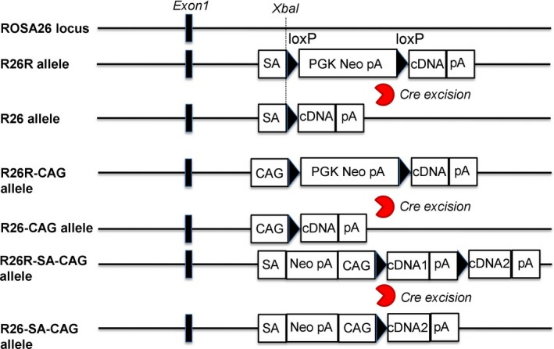
1) Reporter lines Fluorescent proteins (GFP, EYFP, tdTomato, etc.) or enzyme reporters (lacZ) are inserted into the ROSA26 locus, combined with loxP-STOP-loxP (LSL) elements, to achieve Cre-dependent permanent labeling. Widely used in cell lineage tracing, in vivo imaging, and cell morphology analysis.
2) Inducible Cre tools (e.g., ROSA26-CreERT2) A CreERT2 fusion protein is inserted into ROSA26. Without tamoxifen, Cre remains cytoplasmic and inactive; upon administration, Cre translocates to the nucleus, enabling temporally controlled, spatially specific gene knockout/activation across nearly all cell types. It is a core tool for developmental biology, functional genomics, and disease mechanism research.
3) Conditional expression and disease models Strong promoters such as CAG drive the gene of interest, combined with LSL elements, to activate oncogenes or mutant alleles (e.g., PIK3CA H1047R) in specific tissues or at chosen time points, generating inducible tumor and other disease models.
4) Humanization and gene therapy research Human cDNAs can be site-specifically inserted into ROSA26 to generate genetically stable humanized mice for drug evaluation, antibody PK studies, and gene therapy vector research.
With its broad, stable, and safe expression characteristics, the ROSA26 locus has become the most classic and versatile KI locus in the gene-edited mouse field. From reporter-based lineage tracing to inducible Cre tools, and from humanized models to disease models, ROSA26 mice have permeated nearly every corner of modern biomedical research. They are an indispensable foundational tool for functional genomics and precision medicine research.