




What Is Tuberous Sclerosis Complex?
Tuberous Sclerosis Complex (TSC) is a rare autosomal dominant multisystem genetic disorder that primarily damages the brain, skin, kidneys, heart, lungs and other organs. Its hallmark clinical manifestations include cortical tubers, recurrent epilepsy, intellectual disability, facial angiofibromas and renal angiomyolipomas (AML). The global incidence ranges from 1 in 6,000 to 1 in 10,000, making it the most common neurocutaneous syndrome.
Pathogenesis
The core pathogenic driver of TSC is constitutive hyperactivation of the mTOR Complex 1 (mTORC1) signaling pathway, triggered by loss-of-function mutations in either the TSC1 or TSC2 gene.
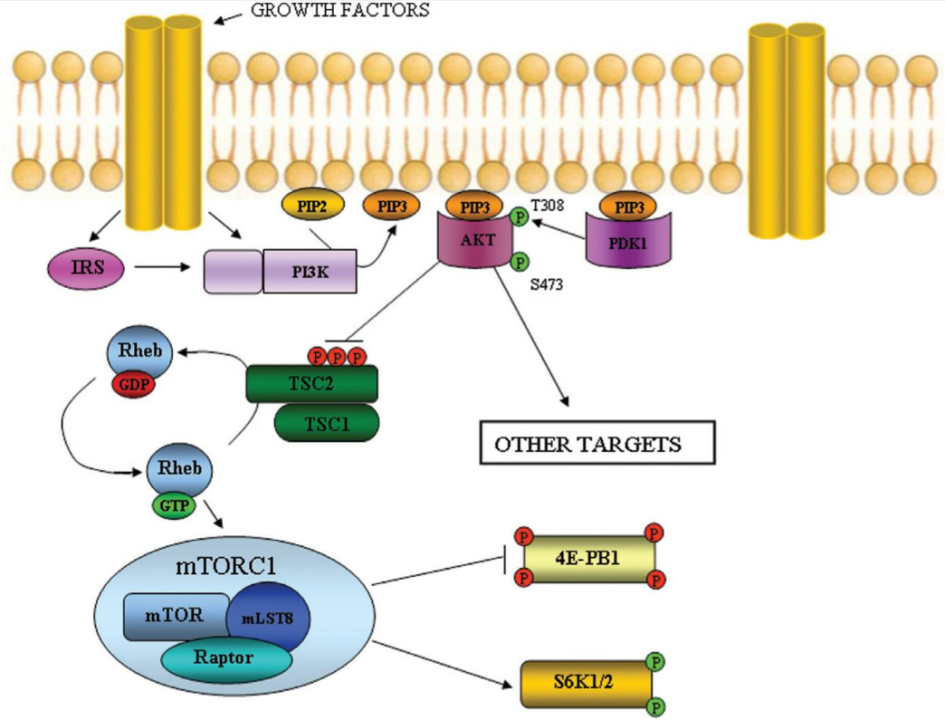
The hamartin protein encoded by TSC1 forms a stable heterodimeric complex with tuberin (product of TSC2). This complex acts as a GTPase-activating protein (GAP) for the small GTPase Rheb. Under physiological conditions, it accelerates GTP hydrolysis of Rheb to lock Rheb in an inactive GDP-bound state, thereby potently suppressing downstream mTORC1 activity.
When pathogenic mutations in TSC1 or TSC2 abolish complex function, active GTP-bound Rheb accumulates abnormally and persistently activates mTORC1. Activated mTORC1 phosphorylates key downstream substrates 4E-BP1 and S6K1/2, relieving translational repression, boosting ribosome biogenesis, and driving aberrant cell proliferation, growth and metabolic reprogramming. This ultimately leads to hamartoma formation and structural lesions across multiple organs.
In addition, growth factors modulate TSC1/TSC2 complex activity via the PI3K-AKT axis:
- Growth factor ligation to membrane receptors recruits adaptor IRS proteins to activate PI3K, which converts membrane PIP2 into the second messenger PIP3.
- PIP3 recruits PDK1 and AKT to the cell membrane; PDK1 phosphorylates AKT at Thr308 to fully activate the kinase.
- Activated AKT phosphorylates multiple residues on TSC2, inhibiting the GAP catalytic activity of the TSC1/TSC2 complex and transiently lifting mTORC1 suppression to support physiological cell growth.
In TSC patients, the baseline inhibitory function of the TSC1/TSC2 complex is permanently eliminated by germline mutations. Upstream AKT signaling loses its physiological target for negative regulation, resulting in unrestrained, chronic mTORC1 hyperactivation and the onset of TSC lesions.
Gene Therapy Strategy: AAV-Mediated Gene Replacement
Adeno-associated viral vectors deliver functional wild-type TSC1 transgenes into the central nervous system to restore normal hamartin expression and re-establish physiological mTORC1 suppression.
Preclinical intracranial AAV9-TSC1 delivery in conditional Tsc1 knockout mice successfully reversed core pathological phenotypes, including reduced cortical tuber burden, suppressed spontaneous seizures and prolonged survival. This represents one of the most promising curative approaches for TSC1-related TSC. In contrast, delivery of full-length TSC2 cDNA remains a major technical bottleneck in the field due to its oversized coding sequence.
Preclinical Mouse Models for TSC Research
- GFAP-Cre; Tsc1flox/flox Conditional Knockout MiceTsc1 is selectively deleted in astrocytes and their progenitor cells. These mice exhibit astrogliosis, impaired neuronal synaptic transmission, spontaneous epilepsy, plus deficits in learning, memory and social behaviors. This model is ideal for dissecting the cellular basis of TSC-associated epileptogenesis and neuropsychiatric comorbidities.
- Nestin-Cre; Tsc2flox/flox Conditional Knockout Mice Neural progenitor-specific ablation of Tsc2 induces severe developmental brain defects, including disorganized cortical architecture, impaired neuronal migration, hypomyelination and intractable epilepsy. It serves as a classic preclinical tool for studying cortical tuber formation and early intervention regimens.
VeloGene Biotechnology Accelerates Rare Disease Gene Therapy R&D
Gene therapy brings transformative therapeutic prospects for rare inherited disorders, yet preclinical mechanism research and therapeutic efficacy validation are fully dependent on standardized, well-characterized animal models.
Powered by our proprietary TurboMice™ technology, VeloGene Biotechnology resolves two longstanding technical bottlenecks of traditional transgenic strain construction: lengthy breeding cycles and low success rates for complex multi-locus genetic modifications. The platform supports precise editing of nearly any target genomic locus and generates fully homozygous gene-edited mouse lines directly from embryonic stem cells in as little as 2 months.
VeloGene Biotechnology provides custom TSC mouse models tailored to experimental demands, including GFAP-Cre Tsc1flox/flox and Nestin-Cre Tsc2flox/flox conditional knockout mice. Academic and industrial researchers are welcome to contact our technical team for project consultations!