




What Is Progressive Familial Intrahepatic Cholestasis?
Progressive Familial Intrahepatic Cholestasis (PFIC) is a group of autosomal recessive hereditary liver disorders caused by pathogenic gene variants. Mutations disrupt hepatocyte bile formation and excretion, which may eventually progress to liver failure. Three classic clinical subtypes have been identified: PFIC-1, PFIC-2 and PFIC-3. The incidence of PFIC-1 and PFIC-2 ranges from 1 in 100,000 to 1 in 50,000 live births.
Pathogenesis
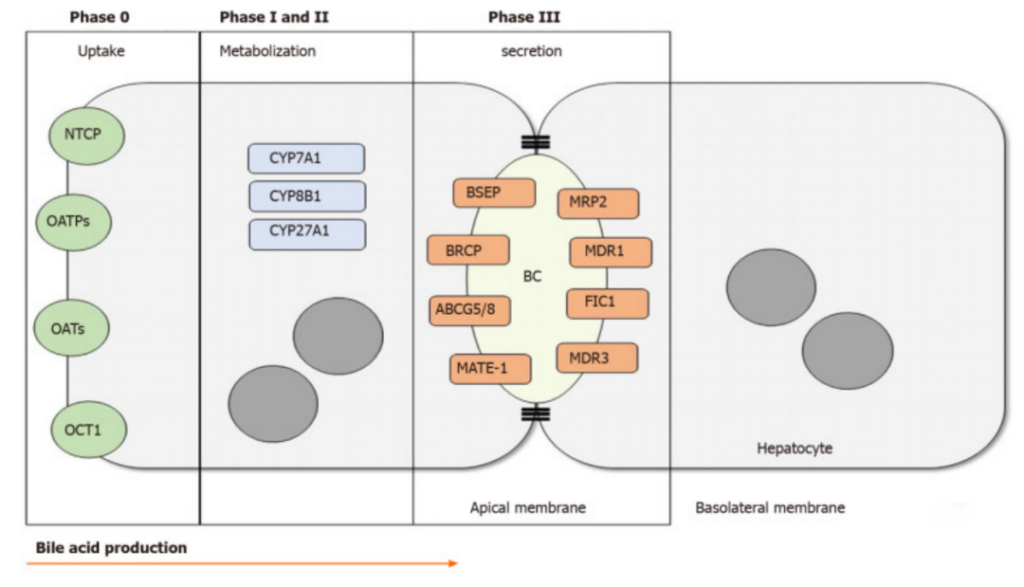
To understand PFIC pathogenesis, we first outline the physiological hepatic bile synthesis and secretion pathway. The liver synthesizes cholic acid (CA) and chenodeoxycholic acid (CDCA) from cholesterol substrates via two biosynthetic routes: the neutral (classical) pathway initiated by CYP7A1 and the acidic (alternative) pathway initiated by CYP27A1. These primary bile acids are conjugated with glycine or taurine to form bile salts.
Biliary transport is divided into sequential phases:
- Phase 0 (basolateral hepatocyte membrane): Hepatocytes uptake precursor substrates via NTCP and OATP transporters;
- Phase I/II: Enzymatic modification and conjugation catalyzed by CYP7A1, CYP8B1 and other metabolic enzymes;
- Phase III (canalicular membrane): BSEP, MDR3 and other transporters secrete bile salts into bile canaliculi to form bile salt-phospholipid mixed micelles.
Cholangiocytes secrete bicarbonate and water through CFTR and chloride-bicarbonate exchangers to dilute bile and reduce viscosity. Bile is stored in the gallbladder and released postprandially. Pathogenic variants disrupting genes encoding key proteins in each phase constitute the root cause of distinct PFIC subtypes.
PFIC-1 (Byler Disease)
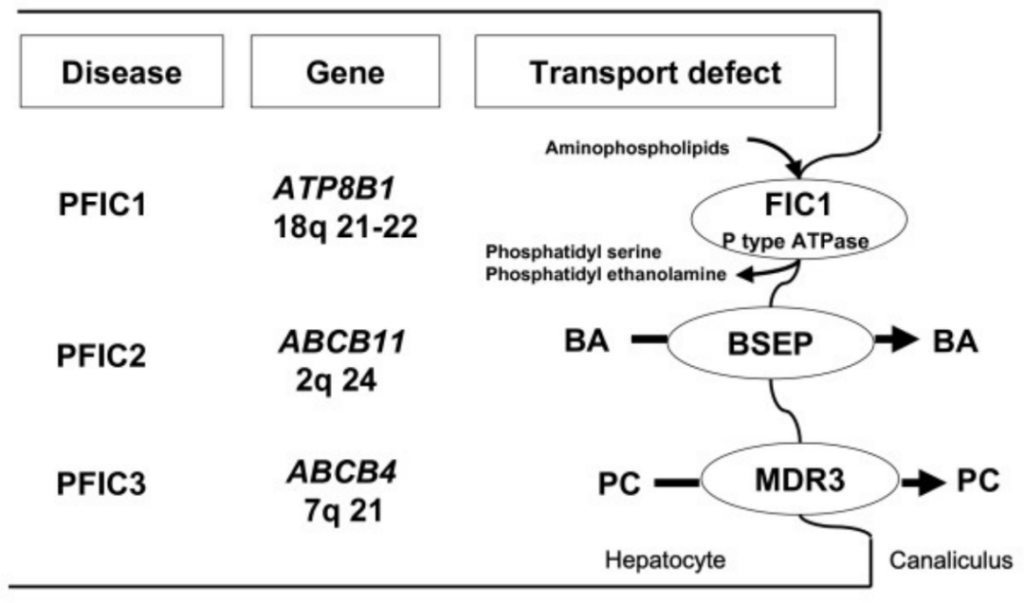
PFIC-1 arises from loss-of-function mutations in ATP8B1, which encodes the FIC1 aminophospholipid flippase localized on the canalicular membrane. FIC1 translocates phosphatidylserine (PS) and phosphatidylethanolamine (PE) from the outer to inner membrane leaflet to maintain lipid bilayer asymmetry. Mutations abolish flippase activity and disrupt membrane structural order.
Impaired membrane integrity reduces resistance to hydrophobic bile salts and suppresses farnesoid X receptor (FXR) downstream bile salt efflux transporters. Combined effects cause massive intracellular bile salt retention, cholestasis, hepatocyte injury and progressive liver fibrosis. Extrahepatic manifestations such as chronic diarrhea and sensorineural hearing loss are also common in PFIC-1 patients.
PFIC-2 (BSEP Deficiency)
PFIC-2 is caused by biallic mutations in ABCB11 (chromosome 2q24), encoding the bile salt export pump (BSEP), the primary canalicular bile salt transporter. Pathogenic variants lead to absent, mislocalized or functionally impaired BSEP protein, triggering severe intracellular bile salt accumulation and profound hepatotoxicity. In addition, defective FXR signaling further impairs bile excretion. Core clinical features include severe intrahepatic cholestasis, low serum gamma-glutamyl transferase (GGT), marked hyperbilirubinemia and elevated early-onset hepatocellular carcinoma risk.
PFIC-3
PFIC is driven by mutations in ABCB4, encoding multidrug resistance protein 3 (MDR3), a canalicular phosphatidylcholine (PC) floppase. PC forms protective mixed micelles with bile salts to neutralize hydrophobic bile acid cytotoxicity. Loss of functional MDR3 drastically reduces biliary PC secretion. Unbound free bile acids directly damage canalicular and cholangiocyte epithelium, triggering cholestasis, cholangitis and ductular proliferation.
Preclinical Mouse Models for PFIC Research
- Atp8b1-/- Knockout Mice Complete ablation of murine Atp8b1, recapitulating both hepatic and extrahepatic pathologies of human PFIC-1 (Byler disease). This model is widely used to investigate mechanisms of phospholipid transport defects, cholestasis, hearing impairment and intestinal epithelial polarity disorders.
- Atp8bG308V Knock-In Mice Carry the human-equivalent G308V missense variant, leading to mislocalized or nonfunctional FIC1 protein in hepatocytes. The strain recapitulates low-GGT cholestasis characteristic of PFIC-1.
- Abcb11-/- Knockout Mice Global knockout of the BSEP transporter gene recapitulates PFIC-2 pathology, ideal for studying bile acid retention-mediated hepatotoxicity, low-GGT cholestasis and hepatocellular carcinoma progression.
- Abcb11E297G Knock-In Mice Engineered with the E297G point mutation causing defective BSEP protein maturation and transport activity. This partial disease model is applied to evaluate therapeutic efficacy of IBAT inhibitors and other PFIC-targeted drugs.
- Mdr2-/- Knockout Mice Murine ortholog of human MDR3, the gold-standard preclinical model for PFIC-3. It lacks biliary phospholipid secretion and develops bile duct injury, portal inflammation and progressive liver fibrosis, commonly utilized to test anti-fibrotic and choleretic therapeutics.
VeloGene Biotechnology Accelerates Rare Cholestatic Liver Disease R&D
Gene therapy brings promising therapeutic prospects for rare inherited cholestatic liver disorders, yet preclinical mechanistic research and therapeutic efficacy validation fully rely on standardized, well-characterized animal models.
Powered by our proprietary TurboMice™ technology, VeloGene Biotechnology resolves two longstanding technical bottlenecks of traditional transgenic strain construction: prolonged breeding cycles and low success rates for complex multi-locus genetic modifications. The platform supports precise editing of nearly any target genomic locus and generates fully homozygous gene-edited mouse lines in as little as 2 months directly from embryonic stem cells.
VeloGene Biotechnology provides custom PFIC mouse models including Atp8b1-/-, Atp8b1G308V, Abcb11-/-, Abcb11E297G and Mdr2-/- knockout strains. Academic and industrial investigators are welcome to contact our technical team for project consultations!