




What Is Ornithine Transcarbamylase Deficiency?
Ornithine Transcarbamylase Deficiency (OTCD), also known as type II hyperammonemia, is an X-linked inherited metabolic disorder caused by loss or impaired activity of ornithine transcarbamylase (OTC) due to pathogenic variants in the OTC gene. It represents the most common urea cycle disorder (UCD), accounting for 50%–67% of all UCD cases, with an incidence ranging from 1 in 80,000 to 1 in 56,500 live births.
The OTC gene maps to Xp11.4, and OTCD follows X-linked incomplete dominant inheritance. Male hemizygous patients typically exhibit severe symptoms, while female heterozygous carriers present variable clinical manifestations ranging from asymptomatic status to severe hyperammonemic crises depending on the degree of X-chromosome lyonization (random X-inactivation).
Pathogenesis
OTCD arises from pathogenic mutations in the OTC gene that disrupt the function of ornithine transcarbamylase, blocking a critical reaction step within the urea cycle.
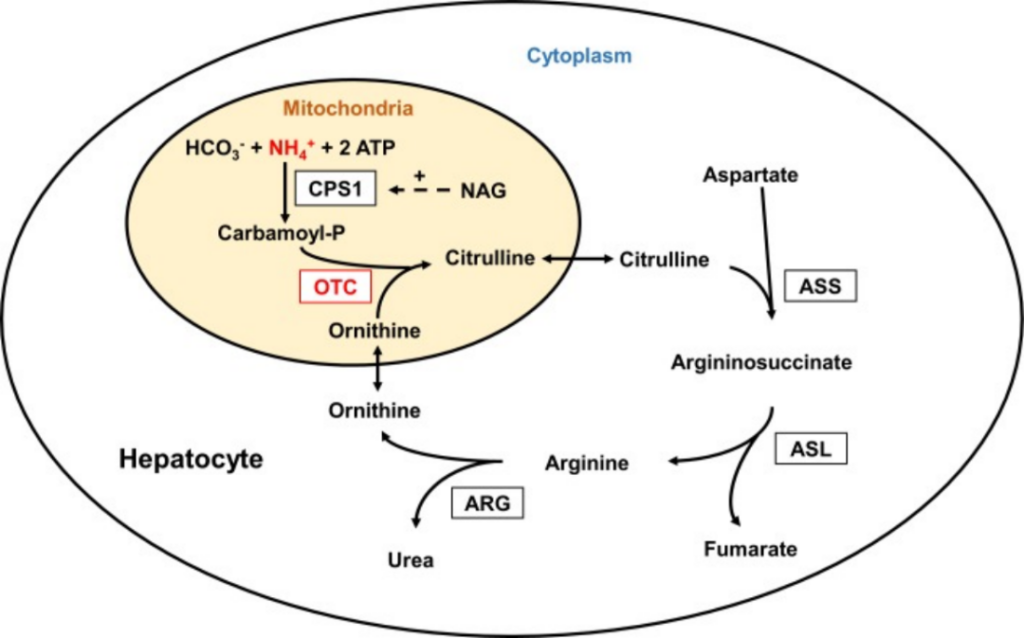
The urea cycle takes place in both the mitochondria and cytoplasm of hepatocytes. Inside mitochondria, carbamoyl phosphate synthetase I (CPS1) catalyzes carbamoyl phosphate synthesis, and OTC further mediates condensation between carbamoyl phosphate and ornithine to form citrulline. Citrulline then translocates into the cytoplasm and undergoes sequential catalysis by argininosuccinate synthetase (ASS), argininosuccinate lyase (ASL) and arginase (ARG) to produce urea and regenerate ornithine, completing the cycle. Impaired OTC activity directly abolishes citrulline production, halting the entire urea cycle and triggering massive systemic accumulation of upstream substrates ammonia and carbamoyl phosphate.
Accumulated ammonia enters the systemic circulation and induces hyperammonemia. Excess ammonia crosses the blood-brain barrier and combines with glutamate to generate glutamine, triggering astrocytic swelling, cerebral edema, impaired energy metabolism (TCA cycle suppression, ATP depletion) and disrupted neurotransmitter balance (glutamate/GABA dysregulation), ultimately leading to acute or chronic encephalopathy, cognitive impairment and epilepsy. Meanwhile, accumulated carbamoyl phosphate diverts into the pyrimidine biosynthesis shunt, conjugating with aspartate to form orotic acid, which is massively excreted in urine as the pathognomonic marker orotic aciduria.
The full-length OTC gene spans 68 kb, comprising 10 exons and 9 introns, encoding a 354-amino-acid protein predominantly expressed in the liver with minor expression in intestinal epithelial cells. Over 400 pathogenic OTC variants have been documented globally, among which missense mutations predominate. Major prevalent variants identified in Chinese populations are listed below:
- p.Arg40His (R40H): Located in exon 2, accounting for 6%–8% of variants. This substitution replaces arginine with histidine at residue 40, disrupting the enzyme active site and protein folding, and frequently leads to severe early-onset hyperammonemia.
- p.Arg129His (R129H): Located in exon 4 with a global prevalence of 3%–4%, usually associated with mild or late-onset clinical phenotypes.
- p.Arg277Trp (R277W): Located in exon 7 (6%–8% prevalence), arising from deamination at a CpG dinucleotide site that alters arginine side-chain hydrophobicity and nearly abolishes OTC enzymatic activity.
- p.Tyr345Thrfs50*: Frameshift mutation in exon 1 generating a truncated protein, classified as a very strong pathogenic variant (PVS1) with complete loss of OTC function.
Preclinical Mouse Models for OTCD Research
- OTC Knockout Mice Complete ablation of the murine Otc gene, modeling lethal severe neonatal OTCD in humans. This strain is ideal for investigating acute metabolic derangements and early lethality mechanisms driven by hyperammonemia and neurotoxicity.
- OTC p.R129H Knock-In Mice Carry the c.386G>A point mutation in Otc exon 4 corresponding to human p.Arg129His. Male hemizygous mice display sparse fur and growth retardation, retaining approximately 5%–10% residual OTC activity, and readily develop acute hyperammonemia under high-protein diet or metabolic stress.
- Liver-Specific OTC Knockout Mice Conditional deletion of Otc exclusively in hepatocytes, recapitulating late/adult-onset OTCD for mechanistic studies of chronic liver injury and tumorigenesis.
VeloGene Biotechnology Accelerates Rare Urea Cycle Disorder Gene Therapy R&D
Gene therapy delivers transformative therapeutic prospects for rare inherited metabolic diseases, yet preclinical mechanistic research and therapeutic efficacy validation fully rely on standardized, well-characterized animal models.
Powered by our proprietary TurboMice™ technology, VeloGene Biotechnology resolves two longstanding technical bottlenecks of traditional transgenic strain construction: prolonged breeding cycles and low success rates for complex multi-locus genetic modifications. The platform supports precise editing of nearly any target genomic locus and generates fully homozygous gene-edited mouse lines in as little as 2 months directly from embryonic stem cells.
VeloGene Biotechnology provides custom OTCD mouse models including OTC knockout mice, OTC p.R129H knock-in mice and liver-specific OTC conditional knockout mice. Academic and industrial investigators are welcome to contact our technical team for project consultations!