




What Is Marfan Syndrome?
Marfan Syndrome (MFS) is an autosomal dominant connective tissue disorder that affects multiple organ systems, primarily the skeletal, ocular, and cardiovascular systems. Typical clinical manifestations include arachnodactyly, scoliosis, lens dislocation, high myopia, and the most life-threatening complication—progressive aortic root dilation and aortic dissection. Aortic lesions constitute the leading cause of mortality among MFS patients.
The incidence of Marfan Syndrome is approximately 1 in 5,000 individuals; around 75% of patients carry a positive family history, while 25% arise from de novo spontaneous mutations.
Pathogenesis
Marfan Syndrome is predominantly caused by pathogenic variants in the FBN1 gene located at chromosomal locus 15q21.1, which encodes fibrillin-1. As a core structural component of the extracellular matrix, mutant fibrillin-1 disrupts elastic fiber architecture and impairs collagen metabolism. Defective connective tissue fibers lead to systemic organ damage, with prominent pathological manifestations in the skeleton and cardiovascular system.
Major categories of pathogenic FBN1 variants are classified as follows:
- Missense mutations (53%–56.1%): Examples include c.6820T>G p.(Cys2274Gly) and c.3605G>T. These variants trigger abnormal protein folding and increase susceptibility to proteolytic degradation, strongly correlated with severe ocular phenotypes such as lens dislocation.
- Nonsense mutations, frameshift mutations and large fragment deletions (combined ~25%): Representative variants include c.4120delC, c.7038_7039del, and c.7412delC. These alterations introduce premature stop codons to generate truncated proteins, and are tightly associated with elevated cardiovascular risks including aortic dissection.
- Splice-site mutations (~12%): Such as intronic variant c.3464-5_3464-4delGAinsAG, which disrupts mRNA splicing machinery to drive disease onset.
- Intronic splice-site base substitutions: May induce abnormal exon skipping and other splicing defects.
Exons 24–32 constitute a well-documented mutational hotspot. Missense variants within this region (such as the classic C1039G) are linked to severe neonatal or early-onset Marfan Syndrome.
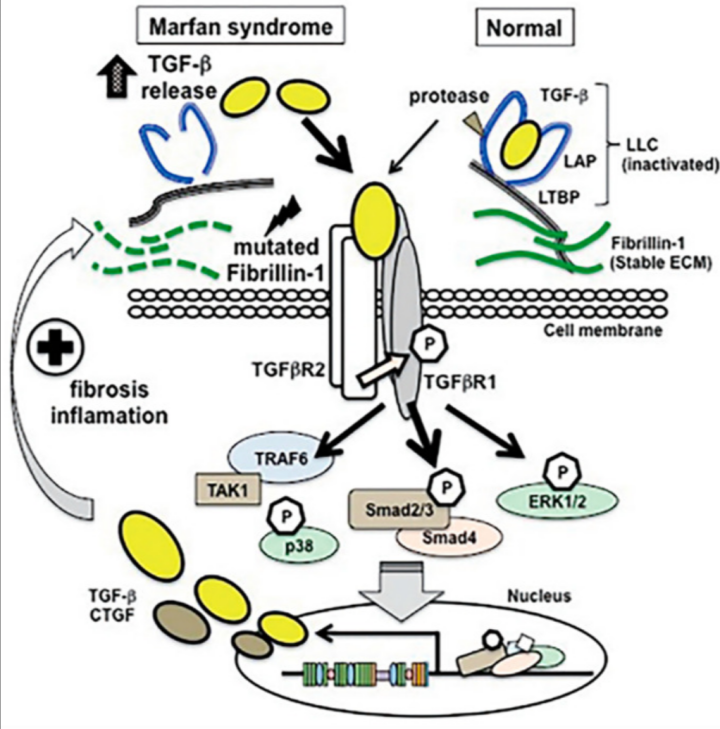
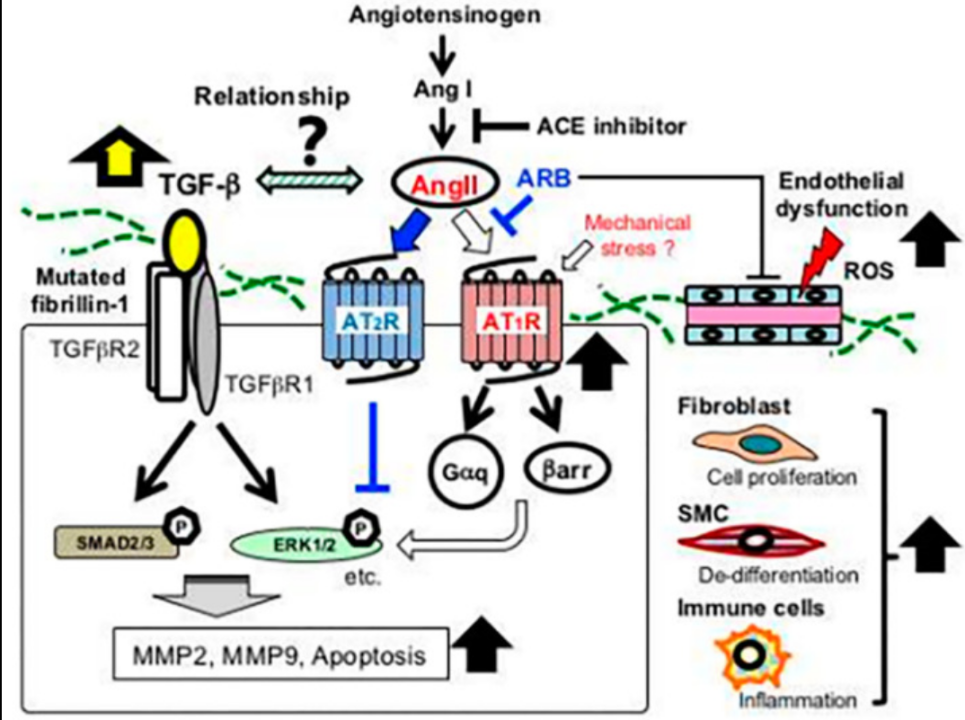
In addition, dysregulation of the transforming growth factor-β (TGF-β) signaling pathway contributes to MFS pathogenesis. In MFS patients, FBN1 mutations trigger excessive release of bioactive TGFβR1 from the extracellular matrix, resulting in hyperactivated TGF-β signaling. This cascade promotes vascular smooth muscle cell apoptosis and extracellular matrix degradation, ultimately destroying aortic wall structural integrity.
Gene Therapy Strategies
- Gene Replacement Therapy Functional wild-type FBN1 transgenes are delivered into patients via adeno-associated virus (AAV) vectors to restore physiological fibrillin-1 expression.
- Gene Silencing Technology Small interfering RNA (siRNA) or antisense oligonucleotide (ASO) platforms specifically silence mutant FBN1 alleles to reduce production of aberrant truncated/misfolded protein.
- Signaling Pathway Modulation Pharmacological or genetic inhibition of the overactive TGF-β signaling axis slows the progression of aortic pathological lesions.
Preclinical Mouse Models for Marfan Syndrome Research
- Fbn1C1039G/+ Mice Carry a missense mutation located in exon 25 of the murine Fbn1 gene. Homozygous Fbn1C1039G/C1039G mice frequently die perinatally due to severe vascular malformations. Heterozygous Fbn1C1039G/+ mice have a normal lifespan and faithfully recapitulate the core pathological hallmarks of human MFS.
- mgΔloxPneo Mice Exons 19–24 of the Fbn1 gene are replaced with loxP and neo cassettes, generating a robust MFS-like disease phenotype. When crossed with Cre-expressing tool strains, this line enables tissue-specific or developmental stage-specific dissection of endogenous Fbn1 function.
- Fbn1mgR/mgR Mice A neo resistance cassette is inserted between exons 18 and 19. Homozygous mice exhibit severe skeletal dysplasia and profound vascular abnormalities, most succumbing to aortic aneurysm or dissection complications in early adulthood.
VeloGene Biotechnology Supports Rare Disease Gene Therapy R&D
Gene therapy opens transformative therapeutic opportunities for rare disorders, yet preclinical development and efficacy validation are fully dependent on standardized, well-characterized animal models.
Powered by our proprietary TurboMice™ technology, VeloGene Biotechnology has developed an extensive panel of rare disease gene-edited mouse models. TurboMice™ resolves two longstanding technical limitations of traditional transgenic model construction: lengthy breeding cycles and extremely low success rates for complex multi-locus gene modifications. This platform supports precise editing of nearly any target genomic locus and generates fully homozygous gene-edited mouse lines directly from embryonic stem cells in as little as 2 months.
VeloGene Biotechnology provides custom Marfan Syndrome mouse models tailored to individual research requirements, including Fbn1
References
[1] Jiang Y, Jia P, Feng X, Zhang D. Marfan syndrome: insights from animal models. Front Genet. 2025;15:1463318. DOI: 10.3389/fgene.2024.1463318. PMID: 39834548; PMCID: PMC11743488.
[2] Lima BL, Santos EJ, Fernandes GR, et al. A new mouse model for marfan syndrome presents phenotypic variability associated with the genetic background and overall levels of Fbn1 expression. PLoS One. 2010;5(11):e14136. DOI: 10.1371/journal.pone.0014136. PMID: 21152435; PMCID: PMC2994728.
[3] Asta L, D’Angelo GA, Marinelli D, Benedetto U. Genetic Basis, New Diagnostic Approaches, and Updated Therapeutic Strategies of the Syndromic Aortic Diseases: Marfan, Loeys-Dietz, and Vascular Ehlers-Danlos Syndrome. Int J Environ Res Public Health. 2023;20(16):6615. DOI: 10.3390/ijerph20166615. PMID: 37623198; PMCID: PMC10454608.