




What Is Fibrodysplasia Ossificans Progressiva?
Fibrodysplasia Ossificans Progressiva (FOP), also known as “Stone Man Syndrome”, is an ultra-rare hereditary connective tissue disorder. Its hallmark clinical features include congenital bilateral great toe malformation, together with progressive, widespread and irreversible heterotopic ossification (HO) of systemic soft tissues, which ultimately leads to severe permanent disability. The global incidence is approximately 1 case per million individuals.
Pathogenesis
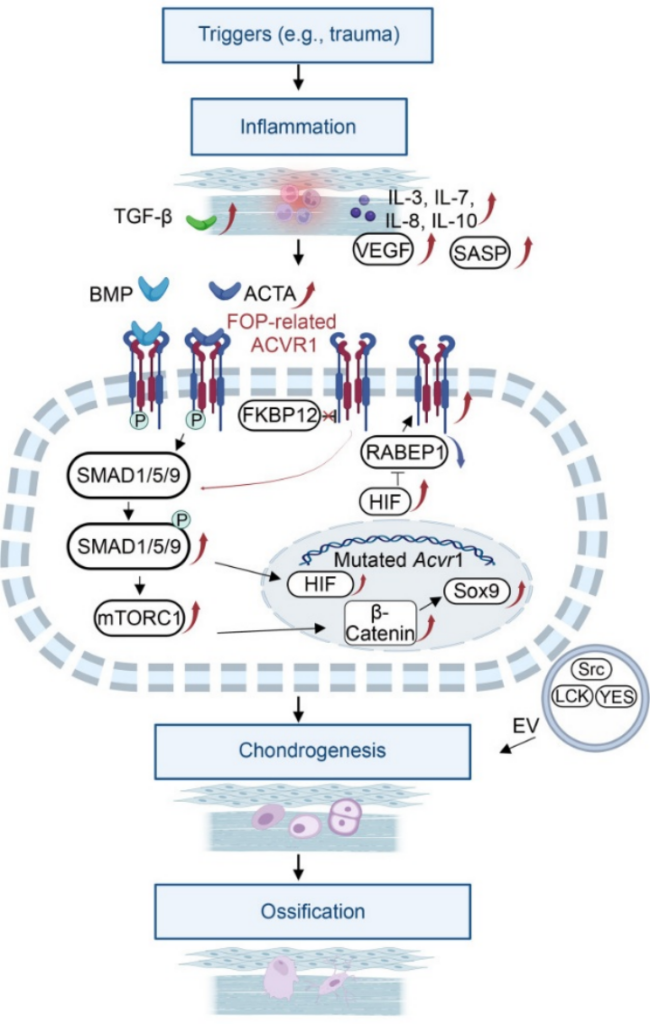
FOP is predominantly driven by pathogenic variants in the ACVR1 gene mapped to chromosomal locus 2q23–24. ACVR1 functions as a type I transmembrane serine/threonine kinase receptor for bone morphogenetic proteins (BMPs). Type I BMP receptors (ACVR1, BMPR1A, BMPR1B) form heterotetrameric complexes with type II BMP receptors (BMPR2, ACVR2A, ACVR2B). Upon BMP ligand binding, type II receptors phosphorylate type I receptors to initiate downstream signaling cascades.
The ACVR1 R206H missense variant disrupts receptor inhibitory function, resulting in constitutive hyperactivation of the SMAD1/5/9 signaling axis and reduced binding affinity for the negative regulator FKBP12, which collectively triggers pathological heterotopic ossification.
In addition, activin A (ACTA), a secreted ligand closely linked to HO progression in FOP, binds ACVR1B to activate SMAD2/3 signaling. It can also interact with the tip loop of ACVR1 to assemble non-signaling complexes (NSCs) together with type II activin/BMP receptors. FOP-causing ACVR1 missense mutations convert inhibitory NSCs into signal-transducing complexes, relieving the physiological suppression of HO.
Beyond ACVR1 and activin A, ligands of the TGF-β/BMP superfamily transmit signals via non-canonical cascades such as TGF-β-activated kinase 1 (TAK1). In FOP patients, macrophages over-secrete TGF-β, triggering sustained activation of NF-κB and p38 MAPK without concurrent elevation of phosphorylated SMAD1/5. This TAK1 pathway dysregulation further accelerates heterotopic bone formation.
Gene Therapy Strategies for FOP
- Gene Silencing Technology RNA interference (RNAi) platforms including short hairpin RNA (shRNA) and small interfering RNA (siRNA) are applied to selectively silence mutant ACVR1 alleles and diminish production of aberrant hyperactive receptor protein.
- Gene Editing Technology Precision gene editing tools such as base editors and prime editors directly correct pathogenic point mutations within the ACVR1 locus to restore normal receptor function.
- Gene Replacement Therapy Viral delivery vectors are utilized to introduce wild-type functional ACVR1 transgenes into patient cells, compensating for defective mutant receptor expression.
Preclinical Mouse Models for FOP Research
- Acvr1R206 FlEx/+ Inducible Conditional Mice This strain enables spatiotemporal control of mutant R206H ACVR1 expression, requiring trauma induction to trigger heterotopic ossification, making it the most physiologically relevant model recapitulating human FOP pathology for mechanistic research.
- Acvr1R206H Knock-In Mice Constitutive ubiquitous expression of the pathogenic variant throughout embryonic and postnatal development causes severe developmental defects and low survival rates. This model is primarily utilized to investigate how ACVR1 mutation disrupts embryonic skeletal patterning.
- Acvr1Q207D Knock-In Mice Carrying the hyperactive ACVR1 Q207D variant, this line exhibits constitutive, robust BMP pathway activation and spontaneous widespread heterotopic ossification, ideal for studying direct downstream consequences of unrestrained BMP signaling.
- BMP4 Overexpression Mice Transgenic overexpression of BMP4 recapitulates the pathological hyperactivation of BMP signaling observed in FOP patients for pathway intervention screening.
VeloGene Biotechnology Accelerates Rare Disease Gene Therapy R&D
Gene therapy delivers transformative therapeutic prospects for rare inherited disorders, yet preclinical mechanism study and therapeutic validation fully rely on standardized, well-characterized animal models.
Powered by our proprietary TurboMice™ technology, VeloGene Biotechnology has generated a comprehensive portfolio of rare disease gene-edited mouse models. TurboMice™ resolves two core technical bottlenecks of traditional transgenic strain construction: prolonged breeding timelines and low success rates for complex multi-locus genetic modifications. The platform supports precise editing of nearly any target genomic locus and generates fully homozygous gene-edited mouse lines directly from embryonic stem cells in as little as 2 months.
VeloGene Biotechnology provides custom FOP research mouse models tailored to individual experimental requirements, including Acvr1<sup>R206 FlEx/+</sup> inducible conditional mice, Acvr1R206H; knock-in mice, Acvr1Q207D; knock-in mice, and BMP4 overexpression mice. Academic and industrial investigators are welcome to reach out for technical consultations!
References
[1] She D, Zhang K. Fibrodysplasia ossificans progressiva in China. Bone. 2018;109:101–103. DOI: 10.1016/j.bone.2017.11.016. PMID: 29175272.
[2] Zhou Y, Shi C, Sun H. Advancements in mechanisms and drug treatments for fibrodysplasia ossificans progressiva. J Zhejiang Univ Sci B. 2025;26(4):317–332. DOI: 10.1631/jzus.B2300779. PMID: 40274382; PMCID: PMC12021541.
[3] Eekhoff EMW, de Ruiter RD, Smilde BJ, et al. Gene Therapy for Fibrodysplasia Ossificans Progressiva: Feasibility and Obstacles. Hum Gene Ther. 2022;33(15–16):782–788. DOI: 10.1089/hum.2022.023. PMID: 35502479; PMCID: PMC9419966.
Previous Article: Rare Diseases Focus | Issue 18: Paroxysmal Nocturnal Hemoglobinuria
Next Article: Rare Diseases Focus | Issue 20: Rett Syndrome