




What Is Congenital Thrombotic Thrombocytopenic Purpura?
Congenital Thrombotic Thrombocytopenic Purpura (cTTP), also named congenital ADAMTS13 deficiency, is an extremely rare inherited hematologic disease. As one of the two major subtypes of thrombotic thrombocytopenic purpura (TTP), it differs from immune-mediated acquired TTP (iTTP) by its core pathogenesis of biallelic pathogenic variants in the ADAMTS13 gene.
The global annual incidence of cTTP is 2 to 6 cases per million population. Its hallmark pathological features include extensive peripheral microthrombus formation, consumptive thrombocytopenia and microangiopathic hemolytic anemia (MAHA).
Pathogenesis
Thrombotic thrombocytopenic purpura (TTP) is categorized into hereditary cTTP and immune iTTP. Though their triggers differ, both are defined by severe deficiency of ADAMTS13 enzymatic activity. cTTP arises from biallelic mutations in the ADAMTS13 gene that abolish production of functional ADAMTS13 protease.
ADAMTS13 is a plasma metalloprotease responsible for cleaving ultra-large von Willebrand factor (UL-vWF) multimers secreted by vascular endothelial cells. Under physiological conditions, ADAMTS13 truncates oversized UL-vWF to prevent excessive platelet adhesion and maintain unobstructed microcirculation. In cTTP patients, gene mutations reduce ADAMTS activity to below 10% of normal levels, leaving UL-vWF uncleared and accumulated in systemic circulation.
Unprocessed UL-vWF exhibits potent platelet-binding capacity, readily capturing circulating platelets to form microvascular thrombi. This process drastically consumes platelets, induces bleeding diathesis and microangiopathic hemolysis, and causes multi-organ ischemic injury.
Baseline ADAMTS13 deficiency often remains subclinical; stressors such as infection or pregnancy stimulate massive endothelial vWF release, fully depleting residual enzyme activity and triggering life-threatening acute crises.
Disease severity correlates with mutation location:
- Mutations within the metalloprotease (MP) domain (e.g., c.2185C>T) frequently disrupt the enzyme active site, leading to severe early-onset neonatal presentations.
- Variants in CUB/Spacer domains (e.g., p.R1060W) primarily impair protein secretion and stability, retaining partial residual enzyme activity and presenting as mild, late-onset disease that first manifests under stress such as pregnancy.
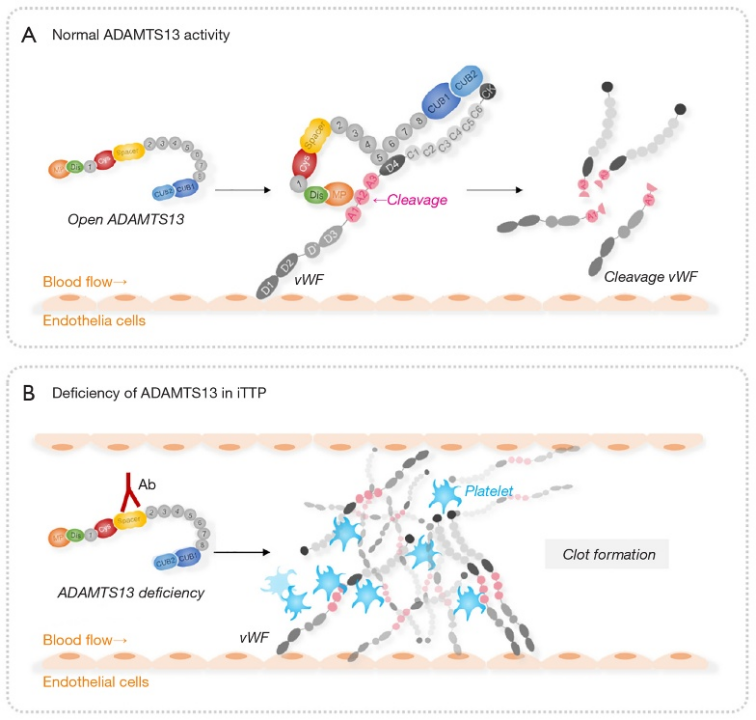
Note: The diagram illustrates microthrombosis driven by ADAMTS13 deficiency using iTTP as an example; cTTP shares identical downstream pathological cascades despite its distinct genetic etiology.
Preclinical Mouse Models for cTTP Research
Three primary mouse strains are widely utilized for cTTP mechanistic and therapeutic research:
- Adamts13 Global Knockout Mice Complete germline deletion of the murine Adamts13 gene. Animals do not spontaneously develop acute TTP under baseline conditions and require secondary stress challenges to recapitulate cTTP pathology. This model is ideal for investigating UL-vWF-mediated thrombogenesis and conducting preclinical efficacy & safety evaluation of recombinant ADAMTS13 replacement and antithrombotic agents.
- Tissue-Specific Conditional Adamts13 Knockout Mice Cell-type restricted ablation via Pf4-Cre (megakaryocyte/platelet-specific) or Tie2-Cre (endothelial-specific) Cre drivers, enabling dissection of distinct physiological and prothrombotic functions of endothelial vs. megakaryocyte-derived ADAMTS13.
- Adamts Truncation / Missense Knock-In Mice Homologous recombination introduces CUB/Spacer domain deletions or humanized missense variants to recapitulate mild, stress-triggered late-onset cTTP phenotypes seen in patients with CUB/Spacer mutations. This model supports domain-specific protein functional studies of mild disease pathophysiology.
VeloGene Biotechnology Accelerates cTTP Gene Therapy R&D
Gene therapy delivers transformative prospects for rare inherited hematologic disorders, yet preclinical mechanistic research and therapeutic efficacy validation fully rely on standardized, well-characterized animal models.
Powered by our proprietary TurboMice™ technology, VeloGene Biotechnology resolves two longstanding technical bottlenecks of traditional transgenic strain construction: prolonged breeding cycles and low success rates for complex multi-locus genetic modifications. The platform supports precise editing of nearly any target genomic locus and generates fully homozygous gene-edited mouse lines directly from embryonic stem cells in as little as 2 months.
VeloGene Biotechnology provides custom cTTP mouse models including global Adamts13 knockout mice, conditional Adamts13 knockout mice, and Adamts13 truncation/missense knock-in strains. Academic and industrial investigators are welcome to contact our technical team for project consultations!