



In patients with advanced cancer, cachexia — a state characterised by severe weight loss, appetite loss and rapid muscle wasting — has long posed a major clinical challenge. Once regarded as a mere side effect, cachexia is now understood to be driven by a core mediator: Growth Differentiation Factor 15 (GDF15), which is emerging as a cross‑disciplinary research hotspot. GDF15 serves as a key node linking the brainstem appetite centre to tumour immune evasion, demonstrating substantial translational value in metabolic dysregulation, tumour‑microenvironment remodelling and immunotherapy resistance.
Core Mechanism: GDF15 → GFRAL → Hindbrain, and Beyond to the Immune Microenvironment
GDF15 belongs to the TGF‑β superfamily. Its basal expression is extremely low in normal tissues but rises markedly under conditions of tumour burden, ischaemic inflammation, chemotherapy‑induced injury or metabolic stress. Its best‑characterised mechanism involves binding to the receptor GFRAL in the area postrema (AP) of the hindbrain, where it cooperates with RET to form a signalling complex that directly acts on the brainstem appetite centre, causing anorexia, nausea and aberrant energy expenditure.
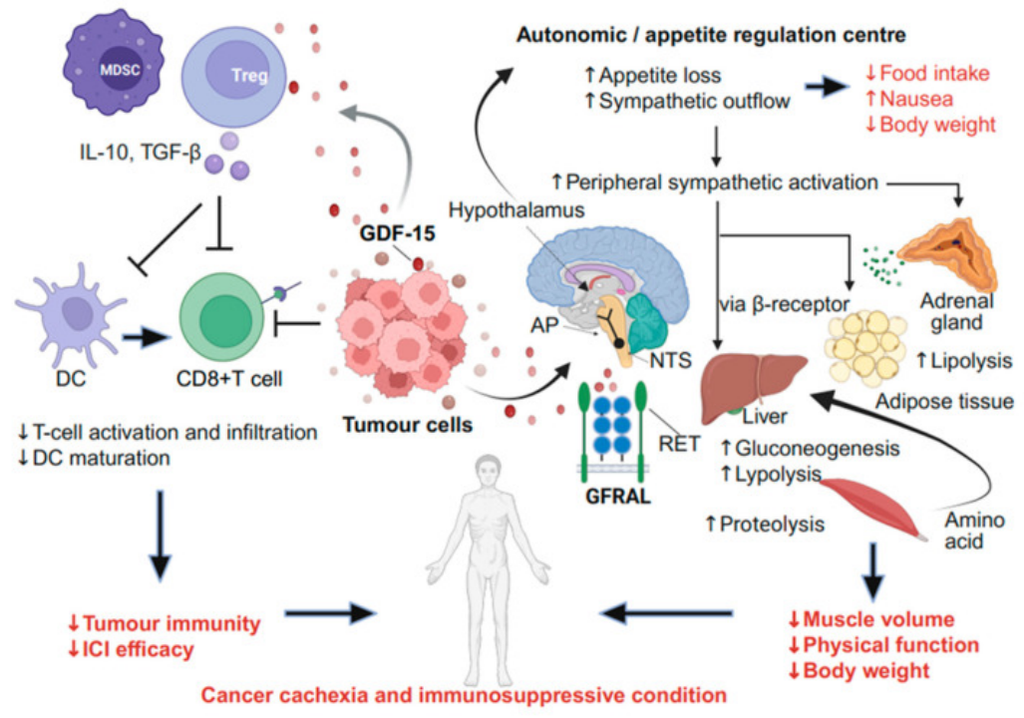
Beyond metabolic regulation, GDF15 plays an even more critical role in the tumour immune microenvironment. It can be secreted by tumour cells, cancer‑associated fibroblasts (CAFs) and M2 macrophages. By suppressing T‑cell infiltration, promoting T‑cell exhaustion and activating pathways such as PI3K/AKT and MAPK/ERK, GDF15 helps tumours establish an immune‑exclusion barrier and induces chemoresistance. Accordingly, its positioning in the field has been upgraded from an “antiemetic and weight‑gain target” to an “immune‑microenvironment‑modulating target” and an “immunotherapy‑sensitising target”.
VeloGene Biotechnology TurboMice™: Rapid Generation of GDF15 Mouse Models
GDF15 research relies heavily on Gdf15 KO, Gfral KO, humanised and overexpression mouse models for mechanistic validation and efficacy assessment. However, conventional hybridisation‑based model generation is time‑consuming and introduces substantial background interference, making it difficult to meet the demands of today’s rapidly iterating combination‑therapy studies.
Powered by TurboMice™ tetraploid‑complementation technology, VeloGene Biotechnology bypasses labour‑intensive breeding and screening. Fully homozygous gene‑edited mice can be directly derived from embryonic stem cells in as little as two months, providing a one‑stop mouse‑model solution for the GDF15 target — from mechanistic validation to combination‑therapy studies. Researchers are welcome to enquire for custom‑model services.
References
[1] Wischhusen J, et al. GDF‑15: From Biomarker to Novel Targetable Immune Checkpoint. Front Immunol. 2020. [2] Hüllwegen M, et al. GDF15: from biomarker to target in cancer cachexia. 2026. [3] Zhu W, et al. Decoding GDF15: Impact on prostate cancer metabolism, chemoresistance, and clinical applications. Chin Med J. 2026. [4] Sugiyama K, et al. New Horizons with GDF15 in Oncology. Curr Oncol. 2025. [5] MDPI. The Multifaceted Role of GDF15: from Cancer Cachexia to Target Therapy. 2025.