




In July 2026, Nature Reviews Drug Discovery published the article Novel drug targets in 2025. According to its data, among the 94 innovative medicines approved by the world’s four major drug regulatory authorities in 2025, 11 targets represented globally first-in-class mechanisms modulated by marketed drugs, accounting for approximately 11.7% and corresponding to 10 first-in-class therapeutics. The pipeline includes 6 small molecules, 3 monoclonal antibodies and 1 peptide. Notably, two China-originated candidates — Siltartoxatug and Ogtrelvir sodium — were featured in the list.
This milestone signals a shift in novel target discovery away from traditional kinases and GPCRs toward non-classical moieties including phospholipids and mitochondrial proteases, marking a critical watershed where target R&D transitions from incremental exploitation to transformative breakthroughs.
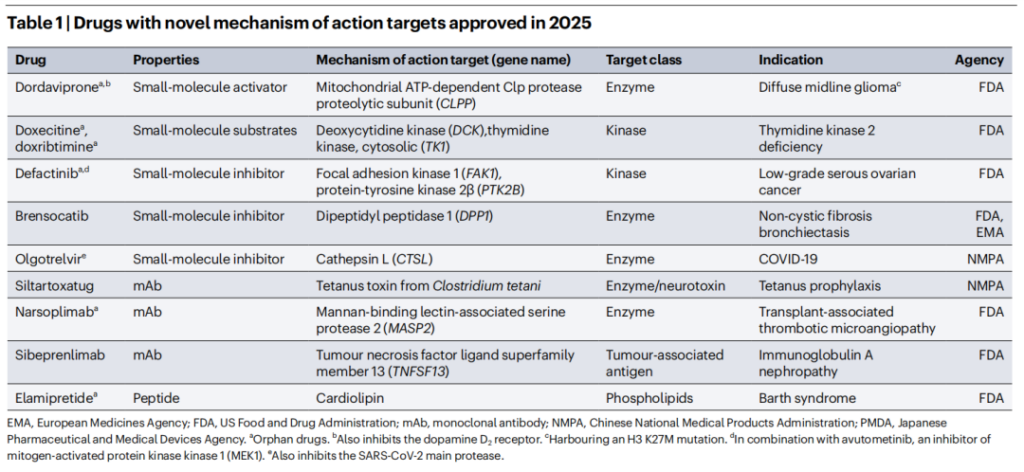
Classification of the 11 Pioneering Targets
The 11 newly validated targets fall into five categories, outlining the full technology and indication landscape of first-in-class therapeutics in 2025:
- 5 Enzymes: DPP1, CTSL, CLPP, DCK, TK2 — Indications: bronchiectasis, COVID-19, diffuse midline glioma, mitochondrial genetic disorders
- 2 Kinases: FAK1 / PTK2B — Indication: KRAS-mutant ovarian cancer
- 2 Complement & Immune Targets: MASP2, TNFSF13 — Address unmet clinical needs in stem cell transplant complications and IgA nephropathy
- 1 Anti-Infective Target: Clostridium tetani neurotoxin — Enables upgraded passive immunotherapy
- 1 Lipid Target: Cardiolipin — Pioneers phospholipid-targeted drug development
Key Trends in Therapeutic Modalities
Small molecules remain relevant, mAbs target underserved pathways, and peptides open new therapeutic categories
The 2025 first-in-class portfolio reveals clear modality differentiation:
- Small molecules: Account for half of new agents, with mechanisms expanded beyond simple inhibition to activation (CLPP), substrate-dependent modulation (DCK / TK1) and host factor regulation (CTSL), demonstrating enduring technical versatility.
- Monoclonal antibodies: Avoid saturated PD-1 immune checkpoint markets, focusing on three hard-to-drug spaces: complement cascades, nephropathy-causing ligands, and bacterial toxin neutralization.
- Peptides: A landmark advance: a peptide agent targeting mitochondrial cardiolipin breaks the long-held paradigm that only proteins are druggable, unlocking an entirely new pipeline for lipid-targeted therapeutics.
Indication Landscape: Rare Diseases & Autoimmunity Dominate First-in-Class Targets
From an indication perspective, rare and autoimmune diseases host the highest concentration of pioneering targets:
7 out of the 11 novel targets correspond to genetic/intractable rare diseases (Barth syndrome, TK2 deficiency, diffuse midline glioma) and autoimmune conditions (transplant-associated thrombotic microangiopathy / TA-TMA, IgA nephropathy).
By contrast, novel oncology and anti-infective targets primarily serve patient subpopulations refractory to existing standard-of-care treatments (e.g., KRAS-mutant ovarian cancer, drug-resistant COVID-19). This trend highlights that first-in-class drug development prioritizes filling unmet clinical gaps rather than competing in crowded therapeutic areas.
Three Strategic R&D Takeaways
- Host factor targets (e.g., CTSL) are sustainable anti-infective avenues, as they evade drug resistance driven by pathogen mutation.
- Mitochondrial targets (CLPP, cardiolipin, downstream TK1 signaling) have translated from basic research to clinical assets, ideal for rare disease and neurodegeneration pipelines.
- Dual-target strategies pairing first-in-class and validated targets (e.g., CTSL + 3CLpro for Ogtrelvir sodium) balance innovation risk and clinical predictability, serving as a replicable R&D model for Chinese biotech teams featured in top international reviews.
Reference
Avram S, Halip L, Curpan R, et al. Novel drug targets in 2025. Nat Rev Drug Discov. 2026;25(7):503.