




Why we took this on?
In early 2020, as the pandemic broke out, the domestic research community faced a shared bottleneck: a shortage of infection models that actually worked.
Why humanization?
The pandemic virus enters cells using ACE2 as its receptor, but mouse Ace2 differs substantially from human ACE2, leaving mice naturally resistant to infection. The key to building an infection model was therefore to make mice express the human ACE2 protein.
Earlier efforts had expressed hACE2 through randomly inserted transgenes or adenoviral transduction, but neither approach reproduced the tissue specificity of hACE2 expression, making it hard to accurately recapitulate the pathology of the disease and limiting their utility.
What was needed was a precise gene-editing approach that drives hACE2 expression in a way that closely mirrors endogenous ACE2.
By knocking in and replacing the mouse Ace2 with the human ACE2 in situ, the mouse would express only the human ACE2 protein, under the control of the endogenous promoter, following the original tissue distribution. Biologically this is the more rigorous path — but it is technically harder and takes longer to build. And the urgent need at the time was precisely a race against the clock.
35 days: we built the model with a technology we had been refining for 15 years
Our core capability is tetraploid complementation.
The principle is straightforward: aggregate gene-edited diploid embryonic stem cells with tetraploid embryos. Because of their abnormal chromosome ploidy, tetraploid embryos do not form fetuses — they develop only into extraembryonic tissues such as the placenta; in turn, that placenta supports the stem cells in developing into a complete fetus. The two complement each other. Every fetus born originates from the stem cells — and since the stem cells carry the gene edit, the resulting mice are directly humanized, with the breeding step completely eliminated.
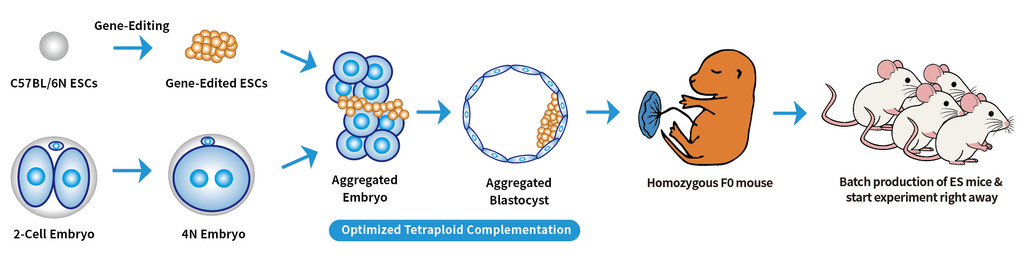
The real barrier to applying tetraploid complementation lies here: with inbred backgrounds and repeatedly passaged ES cells, the success rate of generating tetraploid mice is extremely low — which is exactly why this technology could not be scaled for so long. Our founder, Dr. Guangming Wu, has worked in the fields of embryonic development and genetics since 1995, spending 15 years on early embryo development research at the Max Planck Institute for Molecular Biomedicine in Germany. Through systematic improvements to every step of tetraploid complementation, he raised the success rate from an industry average of 1%–5% to 30%–60%.
It was this capability that carried us through the effort in 2020:
From design to the live birth of homozygous humanized mice — 35 days. The same work through the conventional pipeline would have taken at least six months.
On November 24, 2020, this work was published in National Science Review (2021, 8: nwaa285, DOI: 10.1093/nsr/nwaa285) under the title Rapid generation of ACE2 humanized inbred mouse model for COVID-19 with tetraploid complementation.
Two genetic backgrounds in one go. ACE2 humanized mice were generated simultaneously on both the C57BL/6 and BALB/c backgrounds (B6-hACE2, BALB/c-hACE2); the BALB/c line can be built from female ES cell lines and rapidly expanded through breeding.
Expression follows the endogenous pattern. hACE2 is expressed tissue-specifically in the lung, kidney, testis, intestine and other tissues, with a correct expression pattern.
Solid challenge results. The team challenged B6-hACE2 mice by intranasal inoculation at 2×10⁶ TCID₅₀. The results showed:
- The virus was detected throughout the respiratory system (lung and airways), with a 100% detection rate;
- Viral load peaked on days 1 and 3 after infection, exceeding 10⁶ copies/μg of total tissue RNA and 10⁴ copies/μg of total tissue RNA, respectively;
- Virus-positive cells in the lung were mainly concentrated in the respiratory epithelium;
- The virus was also detected in the small intestine, and high levels were found in feces — consistent with clinical reports of the virus being detectable in human stool and anal swabs, suggesting the model is suitable for studying fecal-oral transmission;
- Viral RNA was rarely detected in kidney tissue — only 1 of 7 mice, on day 1 — suggesting the virus can infect the kidney but at very low levels, consistent with human observations.
Ready for therapy evaluation. When B6-hACE2 mice were pre-treated with a neutralizing antibody, viral load in the lung and airways was markedly suppressed, demonstrating that the model can be used to evaluate anti-viral therapies and vaccines.
Batch delivery without breeding. Target mice can be produced at scale within 35 days. As of 2020, we had supplied several hundred model mice to multiple domestic institutions for drug screening and antibody neutralization experiments.
We turned this capability into a standardized product
In January 2022, MingCeler Biotech was founded to carry the technology accumulated at the laboratory stage and turn tetraploid complementation into an industrializable model-animal platform — TurboMice™.
Compared with the conventional “mice making mice” route — pronuclear microinjection and ES-targeting chimera technology requiring 2–3 generations of breeding and at least 6–8 months — the advantages of TurboMice™ are clear:
- No breeding: F0 founder mice are already the target homozygous mice, ready for experiments in batches;
- Genetic uniformity: mice within the same batch all derive from a single cell, with no chimeras and fully consistent genetic backgrounds;
- Complex model capability: homozygosity and multi-target editing in one step; supports long-fragment and multi-site editing;
- Innovative preservation model: an ES seed bank replaces live colonies or sperm preservation, allowing large-scale recovery of any preserved strain within 2 months;
- Delivery timeline: homozygous mice delivered in 3–5 months.
Building on this, we continue to upgrade the ACE2 humanized model: four iterations combining enhancer optimization and codon optimization have pushed hACE2 expression ever closer to endogenous levels; we have also stacked features such as progeria, diabetes and hypertension to build severe-disease models that more closely mirror the clinic.
Today, the BALB/c ACE2 humanized mouse is available as one of our standard catalog models, with hACE2 highly expressed in the gastrointestinal tract, heart, kidney, lung, testis and brain — suitable for studies of viral infection mechanisms, antiviral drugs, antibody evaluation and vaccine development.
Internationally, these models are offered through VeloGene Biotechnology, the wholly-owned subsidiary and overseas brand of Guangzhou MingCeler Biotech (www.velogene.com).
The problem MingCeler wants to solve
As the AI wave sweeps through the pharmaceutical industry, one question keeps being asked: what is the core competency that cannot be replaced?
Our answer: the bridge that connects the “computational world” and the “real human body” — the animal model itself.
This is not just rhetoric. AI has already markedly accelerated target discovery and molecular generation and optimization, but the point where drug development truly gets stuck is precisely the step from in silico prediction to validation in a real biological system: does the model hold up in the intact organism? Is efficacy sufficient? Where does toxicity occur? These questions can only be answered with in vivo data. And the turnaround time, complexity and genetic consistency of experimental animals directly determine whether this step can be done both fast and credibly.
This is also the direction MingCeler set on day one: translating fundamental research (embryo development, cell fate reprogramming) into key technologies (tetraploid complementation, gene-edited animal models), then into an industrial platform (TurboMice™), ultimately serving the entire new drug development pipeline. The faster AI runs, the more the upstream step of “building the model” must not become the bottleneck.
About MingCeler Biotech & VeloGene Biotechnology
Guangzhou MingCeler Biotech Co., Ltd. was founded in 2022 and is the first model-animal platform company to achieve industrialized mass production of tetraploid complementation technology (TurboMice™). Its wholly-owned subsidiary, VeloGene Biotechnology, serves as the company’s international brand, bringing TurboMice™-based models to the global market. The company is committed to building a world-leading model-animal infrastructure with disruptive foundational modeling technology, serving innovative drug companies, universities and research institutions at home and abroad. Core members of the MingCeler team come from leading research institutions in China and abroad. The company’s founder, Dr. Guangming Wu, has conducted research in embryonic development and genetics at renowned institutions in the United States and Germany since 1995, and was recruited back to China in 2019. In recognition of his outstanding contributions to embryo development research, Dr. Wu’s name is permanently displayed at the Deutsches Museum in Munich, Germany.
The company has been recognized as a National High-Tech Enterprise and a Guangdong Provincial “Specialized, Refined, Distinctive and Innovative” SME, holds AAALAC International accreditation and ISO 9001 quality management system certification, and was selected for the inaugural National List of Disruptive Technology Entrepreneurship Stars.
References
[1] Liu F-L, et al. Rapid generation of ACE2 humanized inbred mouse model for COVID-19 with tetraploid complementation. National Science Review, 2021, 8: nwaa285. https://academic.oup.com/nsr/advance-article/doi/10.1093/nsr/nwaa285/6000225 (PubMed: https://pubmed.ncbi.nlm.nih.gov/34676093)
[2] PMC free full text of the same paper: https://pmc.ncbi.nlm.nih.gov/articles/PMC7717373/
[3] https://static.nfapp.southcn.com/content/202010/28/c4218007.html
[4] https://static.nfnews.com/content/202003/12/c3247582.html
[5] https://huacheng.gz-cmc.com/pages/2020/04/08/f34d115ecaa546f0a35eb50a15158d21.html
[6] https://www.peopleapp.com/rmharticle/30018080760
[7] https://www.cas.cn/zt/sszt/kxmjxg/3rd/202009/t20200909_4759096.html
[8] https://kiz.cas.cn/kprc/ky/202512/t20251204_8022043.html