




Humanized immune system (HIS) mice are the key bridge connecting in vitro experiments to clinical validation. Their core purpose is to let drugs undergo a “dress rehearsal” in an animal body equipped with human immune responses. Currently, three main construction routes dominate the field: PBMC transplantation, HSC transplantation, and BLT thymus transplantation.
PBMC Transplantation: Low Cost, Short Window — Best for Rapid Screening of T Cell-Directed Therapies
PBMC-humanized mice are generated by injecting human peripheral blood mononuclear cells intraperitoneally or intravenously into immunodeficient hosts, reconstituting an immune system dominated by human T cells within roughly 1–2 weeks. Their core advantages are a short construction timeline and low cost, making them particularly suited to the rapid screening and evaluation of T cell-directed therapies such as T cell engagers (TCEs) and anti-PD-1 monotherapy.
However, PBMC models have two inherent limitations. First, the reconstitution is predominantly T cells, with low numbers of B cells and myeloid cells (lacking the human cytokines required for their survival). Second, mature T cells mount a strong xenogeneic response against mouse antigens, frequently triggering lethal graft-versus-host disease (GVHD), which typically limits the experimental window to just 4–6 weeks and constrains long-term efficacy observation.
Donor variability is the most easily overlooked variable in PBMC models. PBMCs from different healthy donors differ markedly in composition and responsiveness, so multiple donor groups should be used within the same experiment to confirm that efficacy differences stem from the drug itself rather than donor-specific effects.
HSC Transplantation: Multi-Lineage Reconstitution, Long Window — but the Highest Technical Barrier and Cost
HSC-humanized mice are generated by injecting human CD34+ hematopoietic stem cells into myeloablatively conditioned adult immunodeficient mice via tail vein, intraperitoneal, or intraosseous routes, or by intrahepatic injection into newborn immunodeficient mice. Human HSCs develop within the mouse bone marrow microenvironment and can differentiate into multi-lineage immune cells, including T, B, and NK cells, antigen-presenting cells, and myeloid cells.
The core advantages of HSC models: because T cells undergo positive and negative selection in the mouse thymus against mouse MHC, they develop tolerance to the host, GVHD risk is low, and the experimental window can be extended to more than 6 months — suitable for studying disease mechanisms and long-term efficacy that require a complete immune system.
But the costs are equally clear: (1) the mouse thymus cannot provide a human MHC environment, so the number of functional human T cells is relatively limited; (2) the reconstitution period is long (12–20 weeks), with high cost and pronounced donor variability; (3) myeloablative conditioning is required, increasing operational complexity and animal mortality risk.
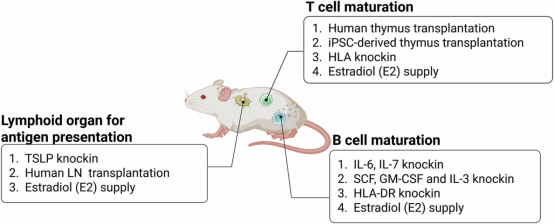
To compensate for insufficient myeloid reconstitution, the field has developed multiple humanized lines expressing human cytokines, such as NSG-SGM3 (also known as NSG-EXL/NOG-EXL) expressing human IL-3, GM-CSF, and SCF, and MISTRG expressing human M-CSF, IL-3, GM-CSF, TPO, and SIRPα — these substantially improve the reconstitution of monocytes, macrophages, DCs, and NK cells.
BLT Human Thymus Transplantation: Solves the Shortage of Functional Human T Cells — but Limited by Donor Scarcity and Ethical Constraints
The most robust humanized immune model is constructed by co-implanting human fetal thymus and liver tissue into IL2RG-deficient mice, followed by infusion of CD34+ HSCs from the same donor — the BLT (Bone marrow–Liver–Thymus) model. The fetal thymus provides an HLA-restricted environment for the development and selection of human T cells, yielding functional, antigen-specific T cell responses — something neither the PBMC nor the HSC route can achieve.
The limitations of BLT models are equally prominent: human fetal thymus and fetal liver tissue donors are extremely scarce, ethical approval is required, and tissue-to-tissue variability is high, making large-scale application difficult. BLT models are therefore mainly used in cutting-edge research on HIV infection, mucosal immunity, and antigen-specific T cell responses, rather than routine tumor efficacy evaluation.
These three routes are not substitutes for one another but are layered and complementary. If the goal is rapid validation of the in vitro activity of T cell-directed drugs, the efficiency of the PBMC model is hard to beat; if the goal is to study complete anti-tumor immune responses or efficacy and toxicity requiring long-term observation, the window and multi-lineage reconstitution of the HSC model are more reliable; and when the research focus is antigen-specific T cell responses per se, only the BLT model provides the irreplaceable human thymus environment. In practical study design, the more prudent strategy is to first use PBMC models for high-throughput screening, then HSC or BLT models for mechanistic validation — letting each model take on the step it is best at.
At VeloGene Biotechnology, our R&D team maintains active engagement with humanized immune system mouse models, covering everything from genetic background selection to the practical evaluation of the PBMC and HSC construction routes. We will continue to share technical insights from our ongoing research as this field evolves.
References
[1] Shultz LD, Brehm MA, Garcia-Martinez JV, Greiner DL. Humanized mice for the study of immuno-oncology. Trends Immunol. 2018;39(9):748-763. DOI: 10.1016/j.it.2018.07.001
[2] Chen J, Liao S, Xiao Z, et al. The development and improvement of immunodeficient mice and humanized immune system mouse models. Front Immunol. 2022;13:1007579. DOI: 10.3389/fimmu.2022.1007579
[3] Ito M, Hiramatsu H, Kobayashi K, et al. NOD/SCID/γcnull mouse: an excellent recipient mouse model for engraftment of human cells. Blood. 2002;100(9):3175-3182.
[4] Park CK, Khalil M, Pham NA, et al. Humanized mouse models for immuno-oncology research: a review and implications in lung cancer research. JTO Clin Res Rep. 2024;6(3):100781. DOI: 10.1016/j.jtocrr.2024.100781
[5] Cosgun KN, Rahmig S, Mende N, et al. Kit regulates HSC engraftment across the human-mouse species barrier. Cell Stem Cell. 2014;15(2):227-238.
[6] Chiang, PC., Lee-Chan, H. & Lee, Y.L. Establishing human immune system mice: application, opportunity, and challenges. Exp Mol Med 58, 2097–2112 (2026).