



Apolipoprotein E (APOE) is a star target in lipid‑metabolism and neurodegenerative‑disease research. Located on human chromosome 19, it encodes a secreted glycoprotein that maintains two independent ApoE pools in the periphery (liver‑derived) and the central nervous system (brain‑derived) respectivelyFrontiers。
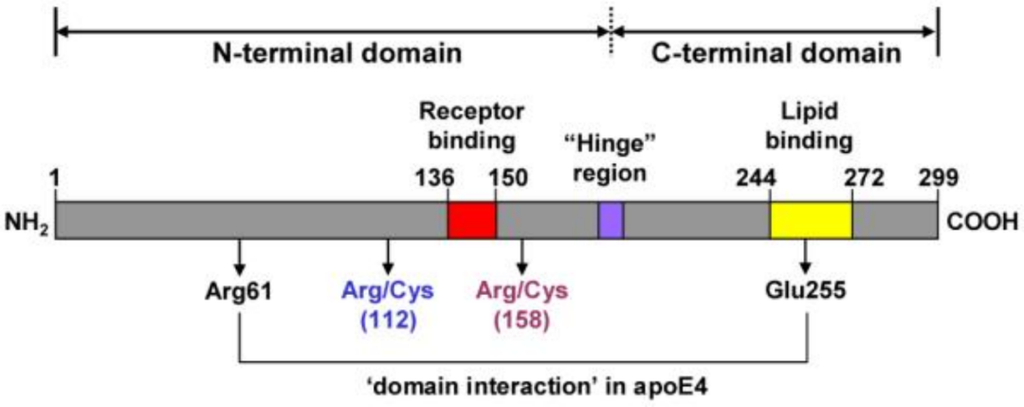
Three major common alleles exist in human populations: ε2, ε3 and ε4, differing only at amino‑acid positions 112 and 158PMC.
- ε3 is the most prevalent allele and generally serves as a neutral control;
- ε2 acts as a protective variant that reduces Alzheimer’s disease (AD) risk;
- ε4 represents the strongest known genetic risk factor for late‑onset AD. Homozygous carriers face a 10‑ to 15‑fold higher disease risk compared with non‑carriersPMC.
APOE establishes relatively independent regulatory networks in peripheral and central compartments, and its genetic polymorphisms (ε2/ε3/ε4) directly shape disease trajectories.
Periphery: Scavenger for Lipid Homeostasis
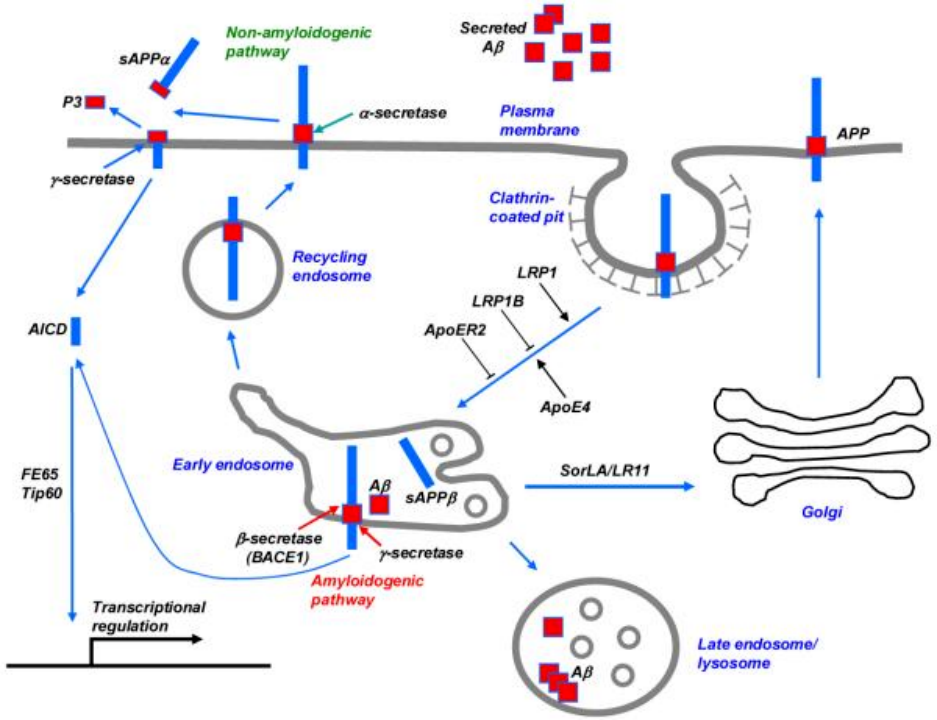
In peripheral circulation, APOE is predominantly synthesized in the liver. Acting as a ligand bound to chylomicron remnants and very‑low‑density lipoproteins (VLDL), it mediates triglyceride and cholesterol clearance via binding to low‑density‑lipoprotein receptor (LDLR) and LRP1PMC.
The three isoforms behave distinctly in peripheral metabolism: ‑ ε2 exhibits weak receptor‑binding affinity and predisposes individuals to type III hyperlipoproteinemia; ‑ ε4 preferentially associates with triglyceride‑rich lipoprotein particles and correlates with elevated cardiovascular‑disease risk.
Central Nervous System: Neuronal Cholesterol Courier
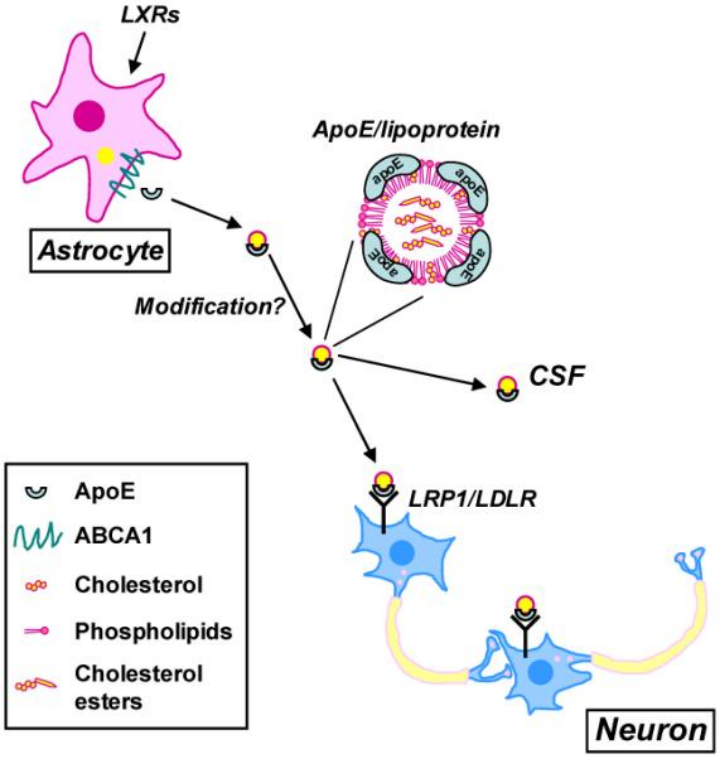
Within the brain, APOE is mainly produced by astrocytes. It undergoes lipidation (loading of cholesterol and phospholipids) mediated by the ABCA1 transporter to form mature ApoE‑lipid complexes. These complexes bind ApoE receptors (LDLR, LRP1, ApoER2) expressed on microglia and neurons, delivering cholesterol for synaptic‑membrane repair, myelination and preservation of synaptic plasticity — the molecular foundation of learning and memoryPMC.
Pathological Amplifier in AD: Multiple Damaging Roles of ε4
The protective physiological machinery turns detrimental in the presence of the APOE ε4 isoform, accelerating AD progression through multiple mechanisms:
- Dysregulated Aβ metabolism: Compared with ε3/ε2, ε4 binds Aβ peptides more readily, promoting misfolding and fibril formation and increasing amyloid‑plaque burden. It also impairs microglial‑mediated Aβ clearance.
- Tau pathology and neuroinflammation: ε4 directly enhances tau hyperphosphorylation and aggregation, while over‑activating microglia to release abundant pro‑inflammatory mediators and establishing a chronic neuroinflammatory niche.
- Cerebrovascular and barrier impairment: ε4 disrupts cerebral‑vascular amyloid clearance (CVS), compromises blood‑brain‑barrier integrity, and induces reduced cerebral blood flow plus impaired glymphatic drainage.
- Bioenergetic crisis: ε4 interferes with ApoER2 / insulin‑receptor signalling, lowering cerebral glucose‑metabolic rate and creating neuronal “energy starvation”.
One Gene, Three Fates
- ε2 (Protector): Boosts lipid clearance and lowers AD risk (with elevated risk for certain vascular abnormalities). It can reverse partial ε4‑driven pathological phenotypes in animal models.
- ε3 (Homeostasis Maintainer): Supports normal lipid trafficking and neuronal function with neutral disease risk.
- ε4 (Disease‑promoter): Exerts adverse effects across Aβ aggregation, tau pathology, neuroinflammation, vascular integrity and brain metabolism; the strongest genetic risk factor for late‑onset Alzheimer’s disease.
ApoE mouse models represent indispensable tools for drug‑discovery and mechanistic investigations. Major available platforms include:
- Apoe‑/‑ knockout mice(Click to see our APOE-KO Mouse Page): Spontaneously develop atherosclerosis; a classic cardiovascular‑research model but unable to recapitulate human allelic differences.
- Targeted‑replacement / knock‑in (TR/KI) mice: Endogenous mouse Apoe coding sequence is replaced by human ε2/ε3/ε4 alleles while preserving physiological expression patterns. These serve as the gold‑standard model for isoform‑comparison studies.
- Tissue‑specific conditional models: Leveraging our proprietary TurboMice™ tetraploid‑complementation technology, VeloGene Biotechnology efficiently generates diverse conditional‑knockout (cKO) mice on ApoE backgrounds. Custom CreERT2‑inducible conditional‑knockout mouse services are also available to meet sophisticated demands for spatiotemporally‑controlled gene editing.
In summary, APOE functions as a central hub linking lipid metabolism, glial biology, Aβ/tau pathology and cerebrovascular homeostasis. For study design: select Apoe‑/‑ for cardiovascular research; TR/KI human‑isoform mice for isoform‑comparison work; and inducible‑switch lines for gene‑correction mechanistic exploration. Driven by precision‑medicine advances, APOE‑targeted interventions are translating from bench‑side to clinical practice, bringing new therapeutic prospects for metabolic and neurodegenerative disorders.