




Biotinidase Deficiency (BTD) is an autosomal‑recessive inherited metabolic disorder. It is caused by pathogenic variants in the BTD gene that reduce or abolish biotinidase activity, impairing the recycling of free biotin. Officially listed in China’s First National Rare Disease Catalogue in 2018, it has an estimated global incidence of ~1 in 60 000. Onset most frequently occurs in infancy, though presentations may also emerge in adolescence or adulthood. Without early detection via newborn screening and biotin supplementation, patients may suffer high rates of disability and mortality resulting from metabolic acidosis, seizures, alopecia, skin rashes and neurodegeneration. BTD stands as one of the classic treatable and preventable rare diseases.
Pathogenesis
BTD pathogenesis follows a pathological cascade: enzyme defect → cofactor depletion → multiple carboxylase inactivation → energy‑metabolism crisis.
Biotinidase hydrolyses biocytin generated from protein turnover and dietary protein‑bound biotin into bioavailable free biotin. Pathogenic BTD variants reduce enzyme activity to < 10 % (profound deficiency) or 10–30 % (partial deficiency). This depletes the free‑biotin pool and inactivates four biotin‑dependent carboxylases simultaneously: propionyl‑CoA carboxylase (PCC), pyruvate carboxylase (PC), acetyl‑CoA carboxylase (ACC), and 3‑methylcrotonyl‑CoA carboxylase (MCC).
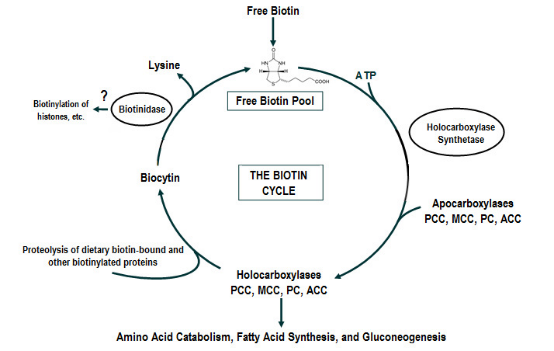
Downstream pathological consequences include:
- Disrupted carbohydrate, lipid and amino‑acid metabolism; accumulation of organic acids such as lactate, pyruvate, 3‑hydroxyisovalerate and 3‑methylcrotonylglycine, triggering ketoacidosis, hyperammonemia and hypoglycemia.
- Impaired mitochondrial ATP production, AMPK activation and mTOR suppression, creating an energy crisis in neuronal cells.
- Preclinical studies in BTD‑knockout mice show thymus and spleen atrophy, elevated CD4⁺ T‑cell proportions, dampened lymphocyte proliferative responses and predisposition to opportunistic candidiasis. This indicates that impaired biotin recycling can secondarily cause cellular immune dysregulation.
- Untreated neuropathy is accompanied by demyelination, axonal degeneration, ventricular dilatation and corpus callosum compression. Some manifestations including hearing loss, optic atrophy and developmental delay may be irreversible even after biotin replacement therapy.
Preclinical Mouse Models for BTD Research
BTD mouse models fall into two major categories: constitutive gene‑knockout spontaneous‑disease models and dietary‑challenge combinatorial models.
1. Btd‑/‑ Knock‑out Mice (C57BL/6 background)
This is the gold‑standard model for investigating BTD pathogenesis. Targeted deletion of the murine Btd gene yields animals with undetectable serum biotinidase activity. Under standard chow, phenotypic changes are mild. When fed a low‑biotin diet, mice recapitulate key features of human profound BTD within days to two weeks: neurological manifestations (hypotonia, seizure‑like episodes, ataxia, sensorineural hearing loss), mucocutaneous lesions (eczematous rash, alopecia, conjunctivitis), elevated urinary 3‑hydroxyisovalerate, mild hyperammonemia and impaired lymphocyte proliferation.
Advantages: well‑defined genetic background; reversible phenotypes upon biotin supplementation.
2. Low‑biotin Dietary‑Challenge Models
On a non‑knockout genetic background, low‑/biotin‑free diet induces subclinical biotin deficiency. This setup enables researchers to dissect the respective pathological contributions of intrinsic enzyme deficiency versus biotin nutritional status. These models are widely used to study carboxylase re‑activation thresholds, AMPK‑mTOR signalling responses and immune phenotypes. They also serve as a surrogate for partial BTD (10–30 % residual enzyme activity).
3. Humanized and Gene‑therapy Validation Models
With advancing BTD gene‑therapy research, investigators introduce human BTD cDNA expression cassettes (e.g. AAV‑delivered constructs under hepatocyte‑specific promoters) onto the Btd‑/‑ knockout background to assess enzyme‑reconstitution efficacy. Though these “gene‑corrected Btd‑/‑” mice do not possess a fully humanized immune system, they directly address critical translational questions: whether restored biotinidase activity reverses organic aciduria and neural demyelination. They act as a bridge connecting basic mechanistic work to gene‑therapy preclinical translation.
VeloGene Biotechnology Supports Gene‑therapy R&D
Gene therapy brings new hope for rare‑disease treatment; nevertheless, its development and validation heavily rely on well‑characterized animal models.
Powered by our proprietary TurboMice™ tetraploid‑compensation technology, VeloGene Biotechnology has generated a broad portfolio of rare‑disease mouse models. TurboMice™ solves two historic bottlenecks in conventional transgenic production: lengthy breeding cycles and low success rates for complex multi‑locus edits. It enables precise genomic targeting and generates fully homozygous gene‑edited mouse lines directly from embryonic stem cells in as little as two months, bypassing time‑consuming conventional breeding and screening workflows.
VeloGene Biotechnology provides custom BTD‑related mouse models to meet project‑specific requirements, including Btd‑/‑ knockout mice, point‑mutation mice carrying human pathogenic variants (e.g. p.R538C, p.Q456H), and human BTD cDNA rescue models. Academic and industrial researchers are welcome to contact our technical team for project consultations!
References
- Wolf B. Biotinidase Deficiency. 2000 Mar 24 [Updated 2026 Feb 19]. In: Adam MP, Bick S, Mirzaa GM, et al., editors. GeneReviews® [Internet]. Seattle (WA): University of Washington, Seattle; 1993‑2026. Available from: https://www.ncbi.nlm.nih.gov/books/NBK1322/
- Pindolia K, Jordan M, Guo C, Matthews N, Mock DM, Strovel E, Blitzer M, Wolf B. Development and characterization of a mouse with profound biotinidase deficiency: a biotin‑responsive neurocutaneous disorder. Mol Genet Metab. 2011 Feb;102(2):161‑169. doi:10.1016/j.ymgme.2010.10.005. PMID: 21051254.
- Pindolia K, Chen J, Cardwell C, Cui X, Chopp M, Wolf B. Neurological deficits in mice with profound biotinidase deficiency are associated with demyelination and axonal degeneration. Neurobiol Dis. 2012 Aug;47(3):428‑435. doi:10.1016/j.nbd.2012.04.016. PMID: 22579707; PMCID: PMC3970768.