




What Is Tyrosinemia?
Hereditary tyrosinemia refers to a group of inherited metabolic disorders caused by enzymatic defects in the tyrosine degradation pathway. Based on distinct deficient enzymes, three major clinical subtypes are recognized: Type I (HT1), Type II (TAT deficiency) and Type III (HPD deficiency).
Hereditary Tyrosinemia Type I (HT1) is the most prevalent and severe subtype, triggered by loss-of-function mutations in the fumarylacetoacetate hydrolase (FAH) gene. Its global incidence is approximately 1 in 100,000.
HT1 is divided into acute and chronic clinical presentations:
- Acute form: Onset in early infancy with rapid progression, marked by severe liver injury, coagulopathy, jaundice and hypermethioninemia, which can quickly progress to fatal liver failure.
- Chronic form: Manifests in late infancy or childhood, characterized by progressive liver fibrosis/cirrhosis and renal tubular dysfunction presenting as Fanconi syndrome, alongside a drastically elevated risk of hepatocellular carcinoma.
Pathogenesis
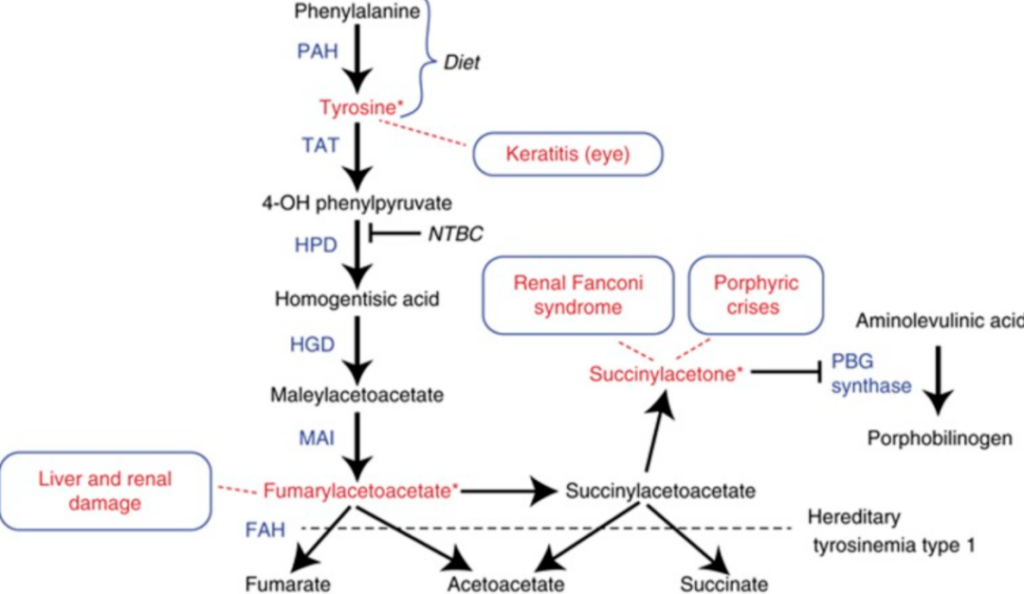
HT1 arises from biallelic pathogenic variants in the FAH gene, which encodes fumarylacetoacetate hydrolase (FAH). Under physiological conditions, tyrosine undergoes sequential enzymatic catalysis by TAT, HPD, HGD, MAI and FAH to produce fumarate and acetoacetate, which enter the tricarboxylic acid cycle for energy metabolism.
Loss of FAH catalytic activity blocks this terminal metabolic step, leading to massive intracellular accumulation of the substrate fumarylacetoacetate (FAA) in hepatocytes and renal tubular cells. Excess FAA is partially converted to succinylacetoacetate, which further generates succinylacetone — the signature toxic metabolite of HT1.
Accumulated toxic intermediates drive multi-organ damage via multiple mechanisms:
- Succinylacetone potently inhibits δ-aminolevulinic acid dehydratase, disrupting heme biosynthesis and triggering buildup of δ-aminolevulinic acid, resulting in neurological and abdominal crises resembling acute intermittent porphyria.
- FAA and succinylacetone alter renal tubular epithelial membrane fluidity and impair tubular reabsorption, causing urinary wasting of glucose, amino acids and phosphate, the hallmark of Fanconi syndrome.
- In the liver, these toxic metabolites directly induce hepatocyte necrosis and apoptosis, disrupt cellular energy homeostasis and trigger persistent oxidative stress, ultimately leading to liver cirrhosis and markedly increased hepatocellular carcinoma susceptibility.
Preclinical Mouse Models for Tyrosinemia Research
Fah-/- Knockout Mice
Global ablation of the murine Fah gene faithfully recapitulates core human HT1 pathological features including acute liver failure and renal tubular lesions. Long-term surviving Fah-/- mice serve a unique research tool to investigate hepatocellular carcinoma driven by chronic liver injury, inflammation and regenerative proliferation.
VeloGene Biotechnology Accelerates Rare Metabolic Disease R&D
Gene therapy brings promising therapeutic prospects for rare inherited metabolic disorders, yet preclinical mechanism research and therapeutic efficacy validation fully rely on standardized, well-characterized animal models.
Powered by our proprietary TurboMice™ technology, VeloGene Biotechnology resolves two longstanding technical bottlenecks of traditional transgenic strain construction: prolonged breeding cycles and low success rates for complex multi-locus genetic modifications. The platform supports precise editing of nearly any target genomic locus and generates fully homozygous gene-edited mouse lines directly from embryonic stem cells in as little as 2 months.
VeloGene Biotechnology provides custom HT1 research models including Fah-/- knockout mice. Academic and industrial investigators are welcome to contact our technical team for project consultations!