




What Is Angelman Syndrome?
Angelman Syndrome (AS) is a neurodevelopmental disorder triggered by dysfunction of the maternally inherited UBE3A gene located on chromosomal region 15q11–13. Its hallmark clinical manifestations include severe developmental delay, intellectual disability, persistent happy demeanor, speech impairment, ataxia, and recurrent epilepsy. The incidence of Angelman Syndrome ranges from 1 in 20,000 to 1 in 12,000 live births.
Pathogenesis
The root cause of AS is the loss of functional maternally derived UBE3A. The UBE3A gene is regulated by genomic imprinting with tissue-specific differential expression: in normal brain tissue, the maternal UBE3A allele is actively transcribed, while the paternal allele remains transcriptionally silenced due to transcriptional interference from the adjacent SNRPN gene. Defects affecting the maternal UBE3A copy lead to the onset of AS, with four major causative mechanisms accounting for all cases:
- Maternal deletion of the 15q11–13 locus (70%–80% of patients);
- Pathogenic variants in the maternal UBE3A gene (10%–20% of patients);
- Paternal uniparental disomy (UPD): complete loss of maternal chromosome 15 with two paternal copies retained (3%–5% of patients);
- Imprinting defects that block normal maternal UBE3A expression (3%–5% of patients).
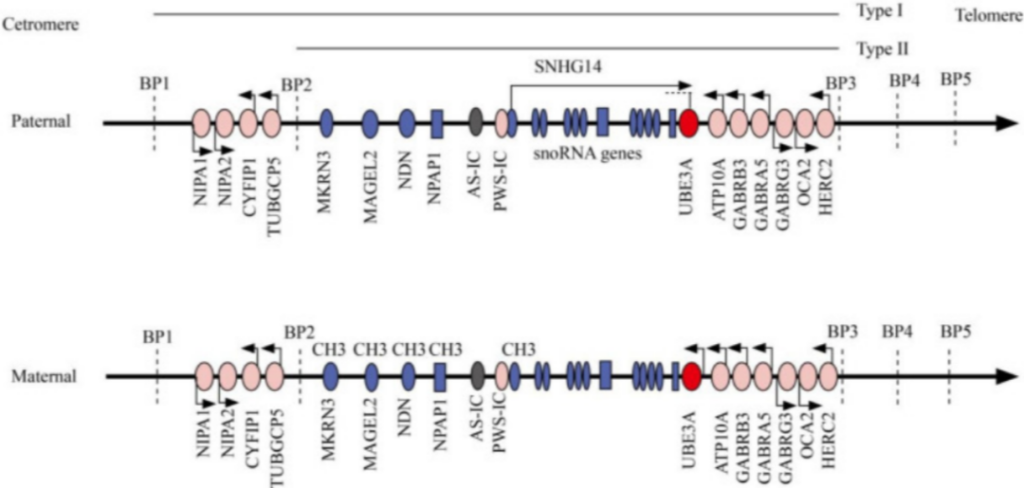
Functionally, loss of catalytic activity of the E6-AP ubiquitin ligase encoded by UBE3A is the core driver of AS pathology:
- Without functional E6-AP, the substrate Ephexin5 fails to undergo ubiquitin-mediated degradation, leading to hyperactivated RhoA signaling, reduced dendritic spine density and impaired synaptogenesis.
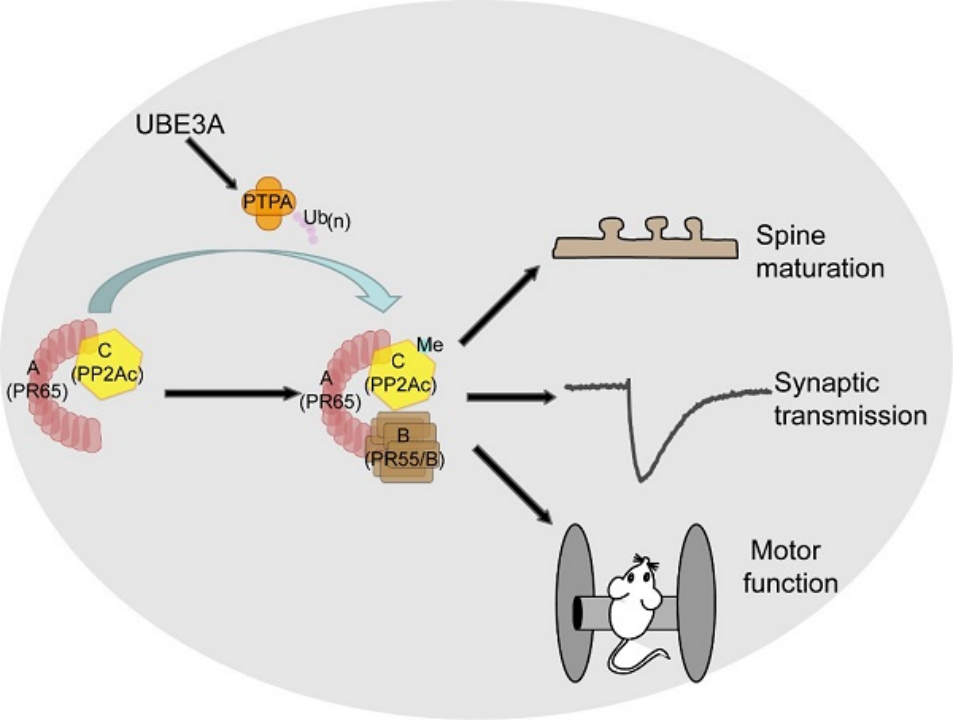
- E6-AP deficiency also prevents proteolytic turnover of PTPA, an allosteric activator of phosphatase PP2A, resulting in abnormally elevated PP2A activity and disrupted neuronal dendritic spine morphology.
- Accumulation of the autophagy regulator HAP1 due to impaired ubiquitination triggers excessive autophagy, further destabilizing synaptic homeostasis.
- As a co-activator of estrogen receptors, dysfunctional E6-AP downregulates Cyp26b1 transcription and disrupts retinoic acid metabolism, impairing learning and memory circuits.
- Dysregulated Na⁺/K⁺-ATPase activity and downregulated miR-708 jointly disturb intracellular calcium signaling.
Collectively, these interconnected molecular cascades induce widespread deficits in synaptic plasticity and cognitive function.
Gene Therapy Strategies for Angelman Syndrome
1. Recombinant AAV-UBE3A Gene Therapy
Intracerebroventricular (ICV) or targeted stereotaxic injection (hippocampus, cerebellum, etc.) of rAAV vectors carrying human wild-type UBE3A restores UBE3A protein expression in maternal Ube3a-deficient mouse models, significantly rescuing motor coordination deficits, cognitive impairment and epileptic susceptibility.
2. Antisense Oligonucleotide (ASO) Therapy
ASOs are designed to selectively suppress transcription of UBE3A-AS (the UBE3A antisense transcript), relieving epigenetic silencing of the paternal UBE3A allele. Preclinical mouse studies have confirmed that this approach successfully reactivates paternal UBE3A expression and partially rescues behavioral abnormalities.
3. RNA Editing Platforms
ADAR-mediated RNA editing systems are engineered to target and degrade or modify the inhibitory UBE3A-ATS long noncoding RNA, thereby de-repressing the silent paternal UBE3A gene.
Preclinical Mouse Models for AS Research
- Ube3am−/p+ Mice Recapitulate maternal 15q11–13 deletion; the strain exhibits motor incoordination, cognitive impairment, heightened seizure susceptibility, sleep disturbance and anxiety-like behaviors, faithfully recapitulating core human AS phenotypes.
- Conditional Ube3a Knockout Mice Cell-type-specific deletion of Ube3a in inhibitory or excitatory neurons, enabling dissection of cell-type-specific neural circuits driving individual AS symptoms.
- Ube3aYFP Reporter Mice YFP fluorescent reporter knocked into the endogenous Ube3a locus for real-time visualization of native UBE3A expression patterns across brain tissue.
- Ube3aSTOP/p+ Mice A Cre-excisable transcriptional STOP cassette inserted into the maternal Ube3a allele to permanently ablate maternal UBE3A function in the absence of recombinase.
- Ube3aT Knock-In Mice Carry a nonsense point mutation on the maternal Ube3a allele that abolishes E6-AP enzymatic activity, recapitulating the molecular pathology of AS caused by loss-of-function UBE3A variants; mice display motor dysfunction, learning/memory defects and impaired synaptic transmission.
VeloGene Biotechnology Accelerates Rare Disease Gene Therapy R&D
Gene therapy opens new therapeutic avenues for rare inherited disorders, yet preclinical mechanism research and therapeutic efficacy validation are entirely dependent on standardized, well-characterized animal models.
Powered by our proprietary TurboMice™ technology, VeloGene Biotechnology has generated a comprehensive portfolio of rare disease gene-edited mouse models. TurboMice™ overcomes two longstanding technical bottlenecks of traditional transgenic strain construction: prolonged breeding timelines and low success rates for complex multi-locus genetic modifications. This platform supports precise editing of nearly any target genomic locus and generates fully homozygous gene-edited mouse lines directly from embryonic stem cells in as little as 2 months.
VeloGene Biotechnology provides custom Angelman Syndrome mouse models tailored to individual experimental requirements, including Ube3am−/p+ deletion mice, conditional Ube3a knockout strains, Ube3aYFP reporter mice and Ube3aT point knock-in mice. Academic and industrial investigators are welcome to reach out for technical consultations!