



What Is Mucopolysaccharidosis?
Mucopolysaccharidosis (MPS) refers to a group of rare hereditary lysosomal storage diseases, triggered by deficiencies of specific enzymes responsible for degrading glycosaminoglycans (GAGs), also known as acid mucopolysaccharides. MPS damages multiple bodily systems, with core manifestations including skeletal malformations, growth retardation, hepatosplenomegaly, cardiac abnormalities, respiratory dysfunction and neurological impairment, severely compromising patients’ quality of life and life expectancy. The overall incidence of MPS is estimated at 1 in 25,000 individuals.
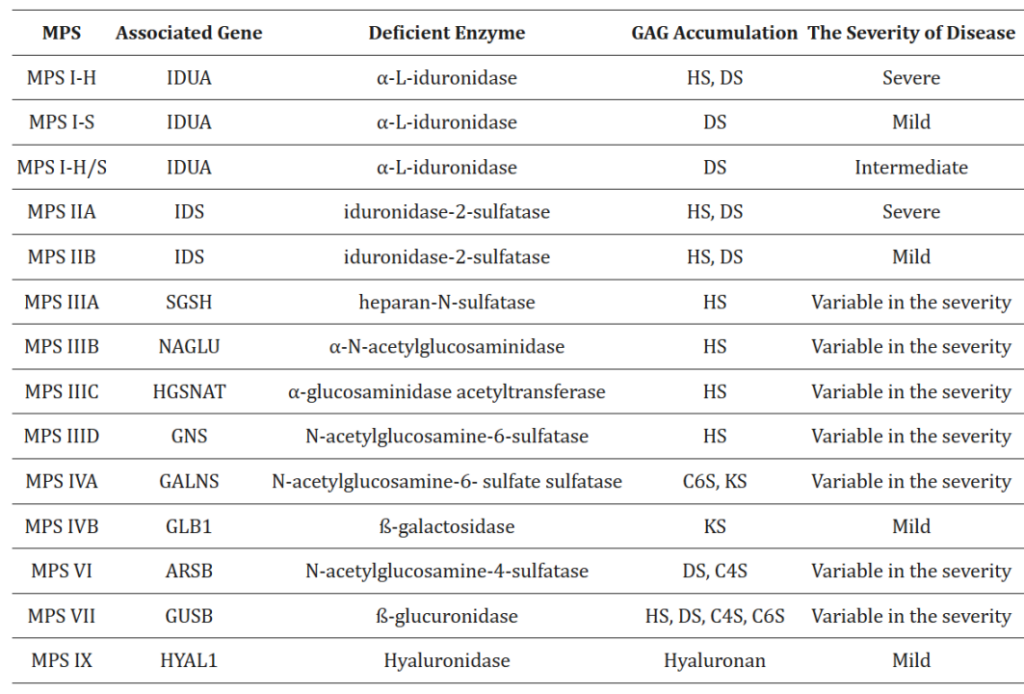
MPS is categorized into seven distinct subtypes (MPS I to MPS IX), each arising from the deficiency of a unique lysosomal enzyme. MPS I was the first subtype to be identified and reported, characterized by the absence of α-L-iduronidase (IDUA).
MPS II is an X-linked recessive disorder that predominantly affects male patients, caused by pathogenic variants in the gene encoding iduronate-2-sulfatase (IDS).
Pathogenesis
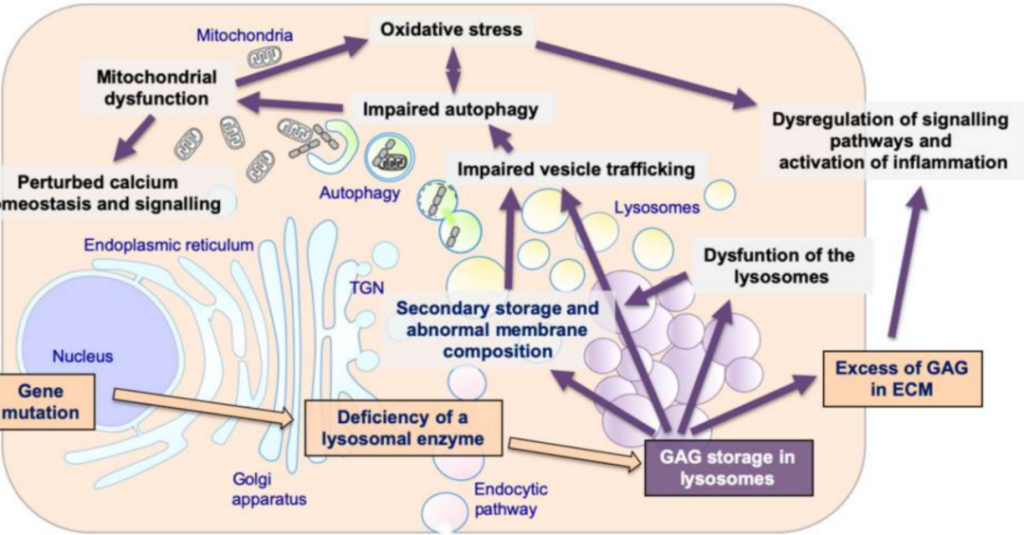
MPS disrupts lysosomal degradation of mucopolysaccharides (glycosaminoglycans, GAGs). As major structural components of the extracellular matrix (ECM), GAGs mediate cell-cell and cell-ECM adhesion. Patients with MPS lack one lysosomal enzyme required for stepwise GAG breakdown, leading to accumulation of partially degraded GAGs within lysosomes and the extracellular matrix.
MPS I (Hurler Syndrome)
MPS I, also named Hurler syndrome, is caused by IDUA deficiency. Loss of functional IDUA leads to widespread deposition of two subtypes of GAGs: dermatan sulfate and heparan sulfate, across all organs and tissues. Pathogenic IDUA variants vary across ethnic populations:
- Globally prevalent variants: p.Trp402Ter, p.Gln70Ter, p.Pro533Arg
- Severe disease-associated variants common in Asian populations: p.Arg89Gln, c.1190-1G>A
Figure Source: PubMed
MPS II (Hunter Syndrome)
MPS II, also called Hunter syndrome, is an X-linked recessive disease driven by mutations in the IDS gene. Loss of IDS enzymatic activity results in systemic accumulation of heparan sulfate and dermatan sulfate, which further triggers secondary buildup of gangliosides and ceramides.
IDS mutations are highly heterogeneous: 82% minor sequence variants, 9% large fragment deletions or duplications, and 9% complex genomic rearrangements.
In Chinese patients:
- p.R468W/Q in exon 9 is a hotspot variant linked to severe MPS II;
- p.R443X and p.G374G are frequently associated with mild MPS II phenotypes.
Gene Therapy Research Progress
1. Therapeutic Strategies for MPS I
- Retroviral Vectors: Ex vivo therapy utilizes retroviral vectors to deliver the IDUA transgene into patients’ autologous hematopoietic stem cells (HSCs), which are subsequently infused back into the patient’s body.
- Adeno-Associated Virus (AAV) Vectors: For in vivo gene therapy, AAV vectors directly deliver the IDUA gene into patients. High-dose intravenous retroviral administration has demonstrated symptom relief in neonatal MPS I mouse models.
- Gene Editing Technology: Gene editing tools combined with lipid-complexed IDUA cDNA are delivered via intravenous injection and have shown therapeutic efficacy in mouse studies. Current limitations include low transfection efficiency, the requirement for elevated systemic IDUA expression levels, and obstacles in cell expansion and storage.
2. Therapeutic Strategies for MPS II
- Adeno-Associated Virus (AAV) Vectors: Intravenous tail vein injection of AAV2/8-TBG-IDS vectors under the liver-specific TBG promoter restores IDS activity in plasma and tissues, and clears accumulated GAGs in MPS II mice. In addition, intracranial delivery of AAV2/5 carrying human IDS cDNA achieves efficient transduction in skeletal muscle, lung and other tissues, alleviating neurodegenerative lesions.
- Ex Vivo Gene Therapy: Patient-derived cells are cultured in vitro, transduced with viral vectors carrying the target gene, and re-infused into the body. Retroviral and lentiviral vectors are the primary delivery systems for this approach. Though still in preclinical development, this strategy has exhibited therapeutic potential in MPS II mouse models.
- Gene Editing Technology: Tools such as zinc finger nucleases (ZFNs) enable targeted DNA cleavage. Combined with exogenous therapeutic transgenes and endogenous cellular DNA repair pathways, precise gene correction can be achieved.
Preclinical Mouse Models for MPS Research
- Idua-/-; Knockout Mice (MPS I Model) Progressive lysosomal storage lesions develop in the liver, spleen, bone, heart and other organs; central nervous system neurodegeneration including cerebellar neuronal loss, neuroinflammation and gliosis; skeletal dysplasia and shortened lifespan.
- Idua W392X Knock-In Mice Recapitulates the human p.Trp402Ter variant; severe widespread deposition of dermatan sulfate (DS) and heparan sulfate (HS) across the liver, spleen, heart, bone, joints and CNS; facial malformations, skeletal dysplasia, severe neurological involvement and drastically shortened lifespan.
- Idua P533R Knock-In Mice Corresponds to the human p.Pro533Arg variant. This missense mutation destabilizes the IDUA protein while retaining partial enzymatic activity, leading to slower and milder GAG accumulation.
- Ids-/- Knockout Mice (MPS II Model) Systemic storage of heparan sulfate and dermatan sulfate; central nervous system impairment including learning and memory deficits with elevated cerebral GAG levels; visceral organ lesions.
- Ids R468W/Q Knock-In Mice Mimics human p.Arg468Trp/Gln variants; systemic accumulation of HS and DS predominantly affecting visceral organs, accompanied by severe central nervous system damage.
VeloGene Biotechnology Accelerates Rare Disease Gene Therapy Development
Gene therapy brings promising therapeutic prospects for rare diseases, yet preclinical development and efficacy validation rely heavily on standardized animal models.
Leveraging our proprietary TurboMice™ technology, VeloGene Biotechnology has generated a comprehensive portfolio of rare disease gene-edited mouse models. TurboMice™ overcomes two core technical bottlenecks of traditional model generation: prolonged breeding cycles and low success rates for complex genetically modified strains. The platform supports precise editing of nearly any target genomic locus and generates fully homozygous gene-edited mouse lines directly from embryonic stem cells in as little as 2 months.
VeloGene Biotechnology provides custom MPS Type I & Type II mouse models tailored to client research demands, including Idua-/- knockout mice, Idua W392X knock-in mice, Idua P533R knock-in mice, Ids-/- knockout mice, Ids R468W/Q knock-in mice and more. Academic and industrial researchers are welcome to contact our technical team for project consultations!
References
[1] Dai YL, Zhu MQ, Zou CC. Research advances in mucopolysaccharidosis type I. Chin J Endocrinol Metab. 2021, 37(4): 306-310. DOI: 10.3760/cma.j.cn311282-20201214-00824.
[2] Yu HF, Qin Q, Wu J, et al. Analysis of pathogenic IDS variants in a pedigree with mucopolysaccharidosis type II. Chin J Endocrinol Metab. 2023, 39(4): 345-352.
[3] Chen GQ, Zhang HW. Genetic diagnosis and treatment of mucopolysaccharidosis type II. J Clin Pediatr. 2024, 42(3): 270-276.
[4] Fecarotta S, Tarallo A, Damiano C, Minopoli N, Parenti G. Pathogenesis of Mucopolysaccharidoses, an Update. Int J Mol Sci. 2020;21(7):2515. doi:10.3390/ijms21072515. PMID:32260444; PMCID:PMC7178160.
[5] Hampe CS, Eisengart JB, Lund TC, Orchard PJ, Swietlicka M, Wesley J, McIvor RS. Mucopolysaccharidosis Type I: A Review of the Natural History and Molecular Pathology. Cells. 2020;9(8):1838. doi:10.3390/cells9081838. PMID:32764324; PMCID:PMC7463646.
[6] Çelik B, Tomatsu SC, Tomatsu S, Khan SA. Epidemiology of Mucopolysaccharidoses Update. Diagnostics. 2021;11(2):273. doi:10.3390/diagnostics11020273. PMID:33578874; PMCID:PMC7916572.
[7] Zhang W, Liu L. Advances in diagnosis and treatment of mucopolysaccharidosis type II. Int J Pediatr. 2022, 49(6):418-422. DOI:10.3760/cma.j.issn.1673-4408.2022.06.015.