




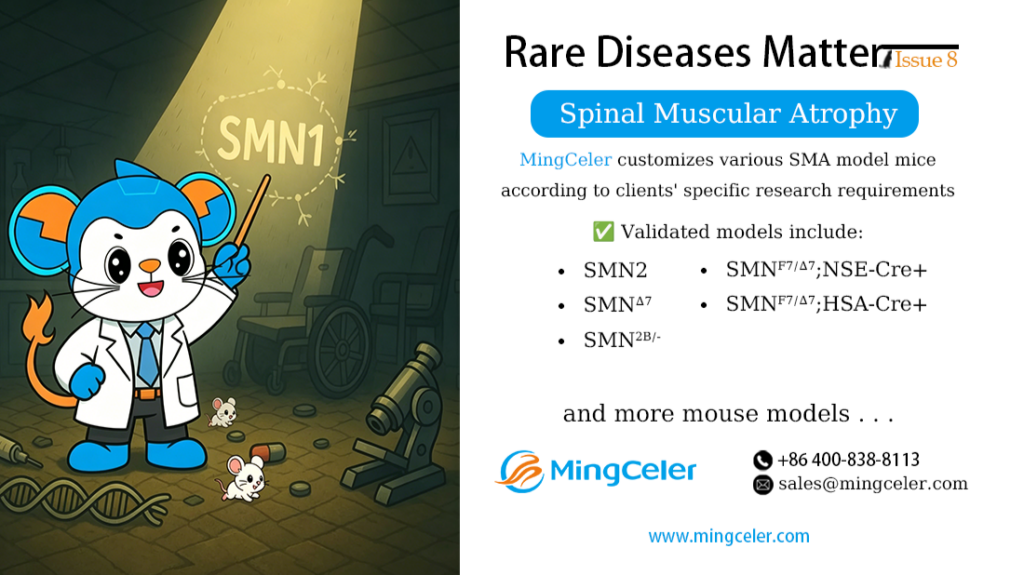
August 7 marks International Spinal Muscular Atrophy (SMA) Awareness Day.
Spinal Muscular Atrophy (SMA) is an autosomal recessive neuromuscular disorder primarily caused by loss-of-function mutations in the survival motor neuron 1 (SMN1) gene. This leads to degeneration of anterior horn motor neurons in the spinal cord, resulting in progressive proximal limb weakness and muscle atrophy. The disease affects motor function and may also involve respiratory, digestive, and skeletal systems.
SMA occurs in 1 in 6,000 to 1 in 10,000 live births and is one of the leading genetic causes of infant mortality. SMA is classified into types I–IV based on age of onset and clinical manifestations; Type I is the most severe, often causing death before age 2.
Pathogenesis
SMA arises mainly from mutations or deletions in the SMN1 gene, located at 5q13.2. The SMN protein is widely expressed and involved in multiple cellular processes, including snRNP assembly. Loss of functional SMN protein leads to selective death of motor neurons.
Humans also carry a highly homologous SMN2 gene. A single point mutation in SMN2 transcripts causes most to lack exon 7, producing unstable, nonfunctional SMNΔ7 protein. SMN2 copy number inversely correlates with SMA severity.

Gene Therapy Approaches
SMN1 Gene Replacement Therapy
Delivers a normal SMN1 gene via viral vectors (e.g., AAV9) to restore SMN protein expression. AAV9 effectively transduces motor neurons and corrects phenotypes in neonatal SMA mice when administered systemically or via intracerebroventricular (ICV) injection. GC101, an investigational AAV9-based therapy developed by Beijing Jinlan Gene Technology Co., Ltd., is administered intrathecally as a single dose to drive SMN1 expression in motor neurons. It has shown significant efficacy in treating SMA Types II and III.
SMN2 Modulation Therapy
Antisense oligonucleotides (ASOs) regulate SMN2 splicing to increase functional SMN protein. ASOs target splicing regulatory sequences to promote exon 7 inclusion. A key target is the intronic splicing silencer ISS-N1 in SMN2 intron 7; blocking it significantly enhances SMN stability and function.
SMA Mouse Models
· SMN2 mice
Knockout of mouse Smn plus insertion of human SMN2. Exhibits rapidly progressive neuromuscular degeneration and severe motor dysfunction. Dies by postnatal day 7 (P7) — a severe SMA model.
· SMNΔ7 mice
SMN2 double-copy background with SMNΔ7 transgene (Smn−/−; SMN2+/+; SMNΔ7+/+). Slightly extended lifespan (~14 days), severe neuromuscular symptoms, closely recapitulating human SMA molecular pathology.
· SMN2B/− mice
Three-nucleotide mutations in the SMN2 exon 7 splicing enhancer region. Express moderate SMN protein levels. Clear neuromuscular phenotype and longer survival; used for mild SMA mechanism studies.
· SMNΔ7; NSE-Cre+ mice
Neuron-specific knockout; lifespan 25–31 days.
· SMNΔ7; HSA-Cre+ mice
Skeletal muscle-specific knockout; lifespan ~33 days.
MingCeler Biotech Empowers SMA Gene Therapy
Rare disease therapies depend heavily on validated animal models. Using its proprietary TurboMice™ Technology, MingCeler has developed multiple rare disease mouse models.
TurboMice™ overcomes traditional bottlenecks: long modeling cycles and low success rates for complex models. It enables editing of nearly any target gene locus and can generate fully homozygous gene-edited mice directly from embryonic stem cells in as little as 2 months.
MingCeler provides custom SMA mouse models, including SMN2, SMNΔ7, SMN2B/−, SMNΔ7; NSE-Cre+, and SMNΔ7; HSA-Cre+ lines. Contact us for inquiries.