




Cystic fibrosis is an autosomal recessive rare hereditary disorder triggered by pathogenic mutations in the CFTR gene located on the long arm of human chromosome 7. Gene defects impair chloride transport across epithelial cells and trigger excessive sodium & water reabsorption, resulting in thick, sticky exocrine gland secretions prone to bacterial infection. Progressive pulmonary damage is the primary fatal cause for CF patients.
Global CF incidence ranges from 1 in 3,500 to 5,000 newborns, while the Chinese incidence is approximately 1 in 64,000, with merely ~200 clinically confirmed domestic cases reported to date.
Pathogenesis

Cystic fibrosis (CF) is an autosomal recessive hereditary disease primarily caused by pathogenic mutations in the CFTR gene. Located on band q3.1 of the long arm of human chromosome 7, the CFTR gene spans approximately 250 kb and comprises 27 exons, encoding a chloride channel protein that governs the transmembrane transport of chloride ions and water across epithelial cell membranes. To date, roughly 2,000 distinct CFTR variants have been identified, consisting of missense mutations (39%), frameshift mutations (16%), splice-site mutations (11%), nonsense mutations (8%), as well as large insertions and deletions (2%).

Classified by functional defects totally of 6, some of them are:
- Class II variants (e.g., ΔF508, ΔI507, N1303K, S541I): Most prevalent CF-causing mutations, inducing abnormal protein folding and intracellular degradation;
- Class III variants (e.g., G551D, G1224E, S1255P): Impair CF channel gating function;
- Class IV variants (e.g., R117H, R334W, R347P): Reduce chloride ion conduction efficiency of CFTR channels.
Main CF Therapeutic Modalities
- CFTR Modulator Therapy: Trikafta (elexacaftor/tezacaftor/ivacaftor) combination drug repairs defective CFTR protein for ~90% CF patient populations;
- Gene Editing Therapy: In 2024, a UT Southwestern team published in Science demonstrating single intravenous LNP-delivered pulmonary gene editing enables long-term CFTR repair lasting the equivalent of a full mouse lifespan;
- mRNA Therapeutics: Vertex & Moderna’s VX-522 (LNP-formulated CFTR mRNA) is currently under Phase 1/2 clinical trials;
- ASO Therapy: SPL84 and other antisense oligonucleotides target splicing defects or overactive ENaC channels;
- AAV-mediated Gene Replacement Therapy: Delivers intact CFTR coding sequence for patients with complete CFTR protein loss.
Mouse Models
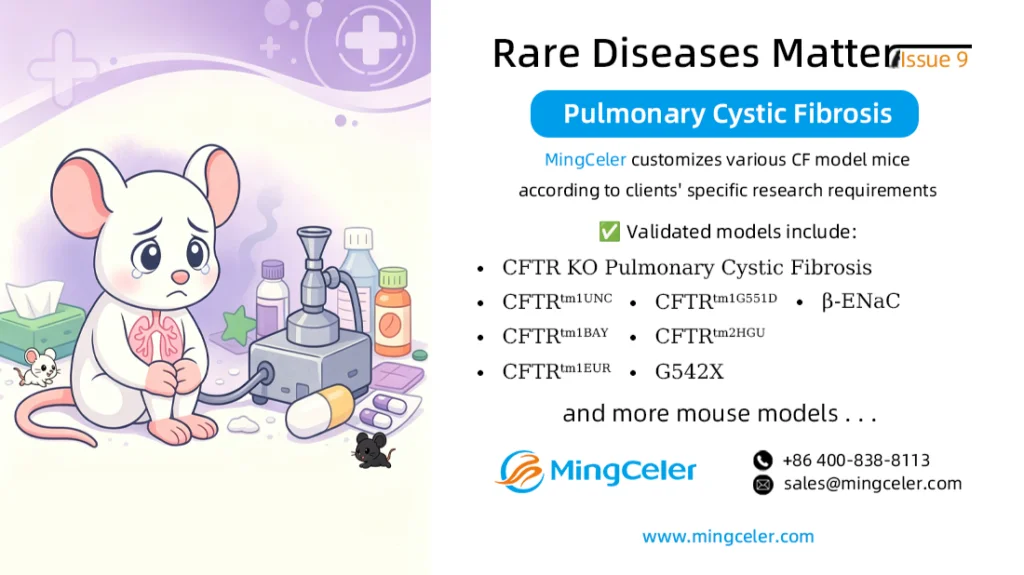
- CFTR Knock-out Mice: Classic KO strain mimicking human CF phenotypes including thickened mucosal epithelium and obstructed exocrine glands for anti-CF drug & pathological research;
- CFTR<sup>tm1UNC</sup>: S489X exon replacement variant, marked by severe intestinal atresia, gallbladder rupture and heightened pulmonary infection susceptibility;
- CFTR<sup>tm1BAY</sup>: Exon 3 insertion mutation, featuring intestinal mucus deficiency and retarded somatic growth;
- CFTR<sup>tmEUR</sup>: ΔF508 (Class II mutation), mild enteric dysfunction without spontaneous pancreatic lesions;
- CFTR<sup>tm1G551D</sup>: G551D Class III variant with mild biliary tract abnormality;
- G542X Mutant: Full CFTR protein depletion from nonsense mutation;
- CFTR<sup>tm2HGU</sup>: G480C mutation with mild intestinal & nasal epithelial electrophysiological defects;
- β-ENaC Transgenic Mice: Overexpressed β-subunit drives excessive sodium uptake, recapitulating CF-like airway mucus retention and inflammation.
MingCeler empowers CF Gene Therapy Research
Validating novel CF therapeutics heavily relies on standardized gene-edited animal models. Powered by proprietary TurboMice™ Tetraploid Complementation Technology / Mice from Cells Platform, MingCeler shortens the conventional lengthy modeling timeline and successfully generates homozygous gene-edited mouse strains in as short as 2 months, supporting targeted editing at nearly any genomic locus.
We provide full bespoke customization for all aforementioned CF mouse lines to support global CRO, biotech and academic R&D teams.