




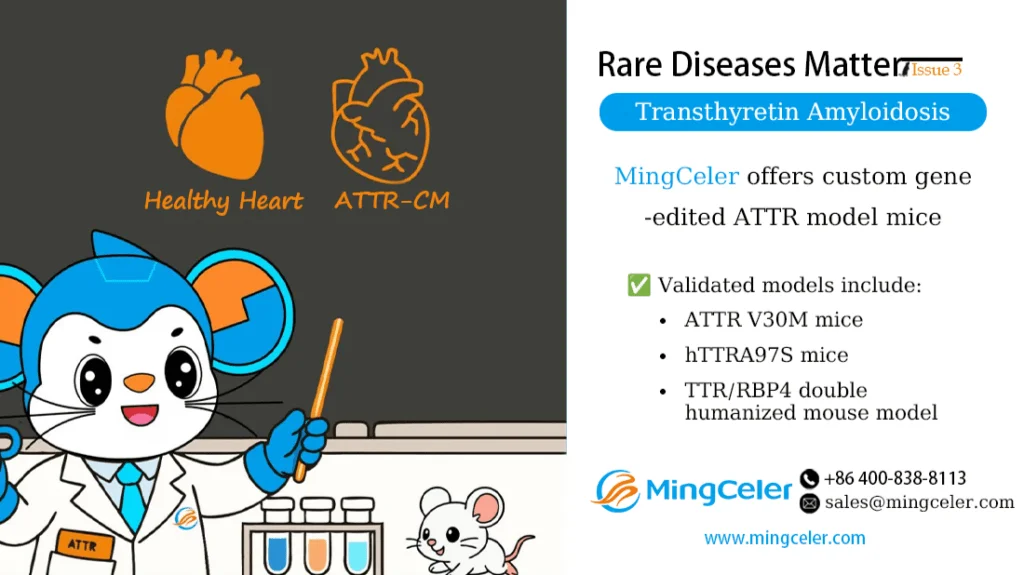
Transthyretin amyloidosis (ATTR) is a rare systemic disorder caused by amyloid deposition of misfolded transthyretin (TTR) protein.
TTR is a 55 kDa protein consisting of 127 amino acids, mainly present in plasma and cerebrospinal fluid (CSF). It transports thyroxine (T4) and retinol-binding protein 4 (RBP4). Misfolding leads to tissue aggregation, amyloid fibril formation, and organ dysfunction.
ATTR has two main types:
- Familial Amyloidotic Polyneuropathy (FAP)
- Cardiomyopathy (ATTR‑CM)
FAP affects the nervous system, causing pain and paresthesia. ATTR‑CM causes myocardial stiffness and heart failure.
Global prevalence of hereditary ATTR (hATTR): 10,000–40,000 cases
Global prevalence of ATTR‑CM: 300,000–500,000 cases
Pathogenesis
TTR amyloidogenesis involves tetramer dissociation, partial unfolding, non‑fibrillar aggregates, protofibrils, and mature fibrils.
TTR mutations reduce protein stability and cause misfolding. More than 120 TTR mutations are associated with ATTR.

Gene Therapy
1. RNA Interference (RNAi)
RNAi is a technology that suppresses specific gene expression via small RNAs (siRNAs). For ATTR treatment, RNAi is used to reduce TTR protein expression. For example, patisiran is an siRNA drug targeting TTR mRNA. Delivered to the liver via intravenous injection, it significantly reduces TTR protein levels in serum.
2. Antisense Oligonucleotides (ASOs)
ASOs are single-stranded DNA or RNA molecules that bind to mRNA and prevent its translation. Inotersen is an ASO drug targeting TTR mRNA. Administered via subcutaneous injection, it reduces serum TTR levels and slows disease progression.
3. Gene Editing
Gene editing treats ATTR by precisely modifying pathogenic loci in the genome. For example, research teams have performed in situ precision gene editing in mouse liver and successfully reduced TTR protein levels. This approach offers the potential for single-dose, permanent reduction of TTR levels, but remains under investigation.
Mouse Models
1. ATTR V30M mice
Human TTR protein can be detected in serum, but no amyloid deposition occurs in the nervous or autonomic nervous systems. Mild TTR amyloid deposition is observed in the kidney, gastrointestinal tract (GIT), and cardiovascular system.
2. hTTR A97S mice
This is a knock-in mouse model carrying the human TTR A97S mutation, characterized by late-onset phenotypes similar to patients with axonal degeneration.Congo red-positive amyloid deposits are detected in the epineurium of the sural nerve, distal renal tubules, and other organs in aged hTTR A97S mice (>2 years), but not in the adult group (8–56 weeks).Aged hTTR A97S mice also exhibit hypersensitivity to mechanical stimuli, lower nerve fiber density, and reduced nerve sensation.
3. TTR/RBP4 double humanized mice
This model is humanized at both the TTR and RBP4 loci to more accurately recapitulate human ATTR pathology. Studies show that these double humanized mice present lower serum hTTR and hRBP4 levels, but display more significant amyloid deposition in the sciatic nerve.
MingCeler Empowers Gene Therapy R&D
Gene therapy relies on validated animal modeling.
MingCeler has developed multiple rare disease mouse models using proprietary TurboMice™ Technology (tetraploid complementation technology).
TurboMice™ overcomes long timelines and low success rates, enabling in situ precision gene editing at nearly any locus. We generate homozygous mice directly from embryonic stem cells (ESCs) in as fast as 2 months, with no allelic segregation distress.
MingCeler provides custom ATTR mouse models including, but not limited to:
- ATTR V30M mice
- hTTR A97S mice
- TTR/RBP4 double humanized mice
Welcome to inquire about customization.
Advantages of MingCeler Mouse Model Services
- Ultrafast: Fully homozygous mice in ~2 months
- Accurate: In situ precision gene editing at ESC level with high tissue specificity
- Efficient: F0 generation ready‑to‑use; maintain genetic integrity; no chimeric mice
- Multi‑choice: Flexible strain selection (C57BL/6, Balb/c, ICR, etc.)
Supported by EnhancerPlus Analysis Platform and efficient tetraploid platform, MingCeler supports multi-locus gene editing, long fragment gene editing, and flexible targeting design.