




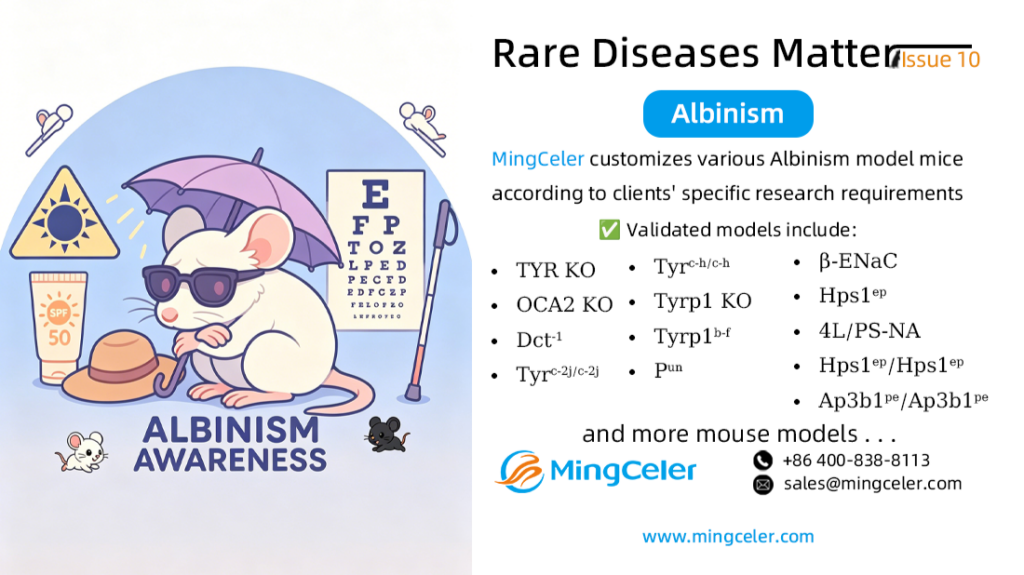
Albinism is a rare hereditary disorder. It is primarily caused by the deficiency or dysfunction of tyrosinase, which disrupts melanin synthesis and leads to pigment loss in the skin, hair and eyes. Without the protection of melanin, patients are vulnerable to ultraviolet radiation damage and often suffer from severe visual impairment. The global incidence of albinism is approximately 1/17,000 ~ 1/20,000, and there are around 70,000 patients diagnosed with this disease in China.
Pathogenesis
The pathogenesis of albinism is mainly linked to defects in tyrosinase, a key enzyme in melanin synthesis. As the initiating enzyme of melanin production, tyrosinase catalyzes the conversion of tyrosine into dopa, which further synthesizes melanin. Mutations in the tyrosinase gene will reduce or completely abolish tyrosinase activity, blocking melanin synthesis and ultimately triggering albinism.
Clinically, albinism is mainly divided into two major categories:
1、Oculocutaneous Albinism (OCA)
- OCA1: Caused by mutations in the tyrosinase (TYR) gene.
- OCA2: Associated with mutations in the OCA2 gene (formerly known as the P gene).
- OCA3: Triggered by mutations in the tyrosinase-related protein 1 (TYRP1) gene.
- OCA4: Resulted from mutations in the gene encoding Solute Carrier Family 45 Member 2 (SLC45A2, formerly named MATP).
- OCA5: Mapped to chromosome locus 4q24, with the specific causative gene yet to be identified.
- OCA6: Caused by mutations in the SLC24A5 gene of Solute Carrier Family 24.
- OCA7: Linked to mutations in the C10orf11 gene.
Generally speaking, all types of albinism are directly or indirectly attributed to impaired TYR function — TYR catalyzes the first step of melanin synthesis. Indirect causes include abnormal folding of TYR, poor trafficking efficiency of TYR to melanosomes (melanin-producing organelles), and unfavorable biochemical conditions for TYR activity inside melanosomes.

2、 Ocular Albinism (OA)
In addition, a small number of patients develop accompanying syndromes, such as Chediak-Higashi Syndrome (CHS) with immunodeficiency and Hermansky-Pudlak Syndrome (HPS) with bleeding tendency.
- The only causative gene for CHS is LYST.
- HPS has up to 10 causative genes: HPS1, AP3B1, HPS3, HPS4, HPS5, HPS6, DTNBPI, BLOC1S3, BLOC1S6, AP3D1.
Point mutations are the predominant gene mutation types in albinism, including missense mutations, nonsense mutations, frameshift mutations and splice-site mutations.

Gene Therapy
- AAV Vector Delivery of Normal Genes: Functional normal TYR genes are delivered into patient cells via adeno-associated virus (AAV) to restore tyrosinase activity. A 2022 study published in Nature Communications confirmed that AAV vectors successfully improved hair pigmentation in mouse models.
- Gene Editing Technology: Directly repair mutated genes to avoid long-term reliance on exogenous gene expression. Its feasibility has been verified in in vitro cell experiments.
- Stem Cell Therapy: Genetically modified induced pluripotent stem cells (iPSCs) are differentiated into melanocytes and transplanted into patients’ skin and retinas, which is expected to achieve long-term therapeutic effects for albinism.
Mouse Models
- TYR Knock-out Mice: Completely deficient in tyrosinase and presenting systemic albinism. Widely used for the research of OCA1.
- OCA2 Knock-out Mice: Simulate OCA2. Abnormal pH of melanosomes leads to impaired pigment synthesis.
- Dct⁻¹ Mice: Applied to study melanocyte development and melanin synthesis.
- Tyrc-2J/c-2J Mice: Carrying tyrosinase gene mutation (c.G291T, p.R77L) and showing systemic albinism.
- Tyrc-h/c-h Mice: Harboring tyrosinase gene mutation (c.A1259G, p.H420R), used for research on tyrosinase dysfunction.
- Tyrp1 KO Mice: Knockout of the tyrosinase-related protein 1 (TYRP1) gene to simulate OCA3.
- Tyrp1b-J Mice: Carrying c.403T>A and 404delG mutations in Tyrp1, for OCA3 research.
- Pun Mice: Core model for OCA2 research. Its mutation causes abnormal pH regulation of melanosomes.
- Hps1ep Mice: Presenting typical HPS symptoms including platelet dysfunction and pulmonary fibrosis.
- 4L/PS-NA Mice: Combining Gba1 V394L mutation and prosaposin knockout. This model develops severe neuropathy accompanied by albinism, simulating rare OCA subtypes with neurological symptoms.
- Hps1ep/Hps1ep Mice: For research on albinism caused by HPS1 gene mutation.
- Ap3b1pe/Ap3b1pe Mice: For research on albinism caused by AP3B1 gene mutation.
MingCeler Empowers Gene Therapy Development
Gene therapy brings new hope to patients with rare diseases, and its research and verification rely heavily on animal models. Leveraging our proprietary TurboMice™ Technology, MingCeler has developed multiple mouse models for rare diseases.
TurboMice™ addresses the pain points of long modeling cycles and low success rates for complex mouse models. It enables gene editing at almost any target gene locus. We can generate complete homozygous gene-edited mouse models directly from embryonic stem cells in as short as 2 months.
MingCeler provides customized albinism mouse models, including TYR Knock-out Mice, OCA2 Knock-out Mice, Dct⁻¹ Mice, Tyrc-2J/c-2J Mice, Tyrc-h/c-h Mice, Tyrp1 KO Mice, Tyrp1b-J Mice, Pun Mice, Hps1ep Mice, 4L/PS-NA Mice, Hps1ep/Hps1ep Mice, Ap3b1pe/Ap3b1pe Mice and more. Feel free to contact us for inquiries!