




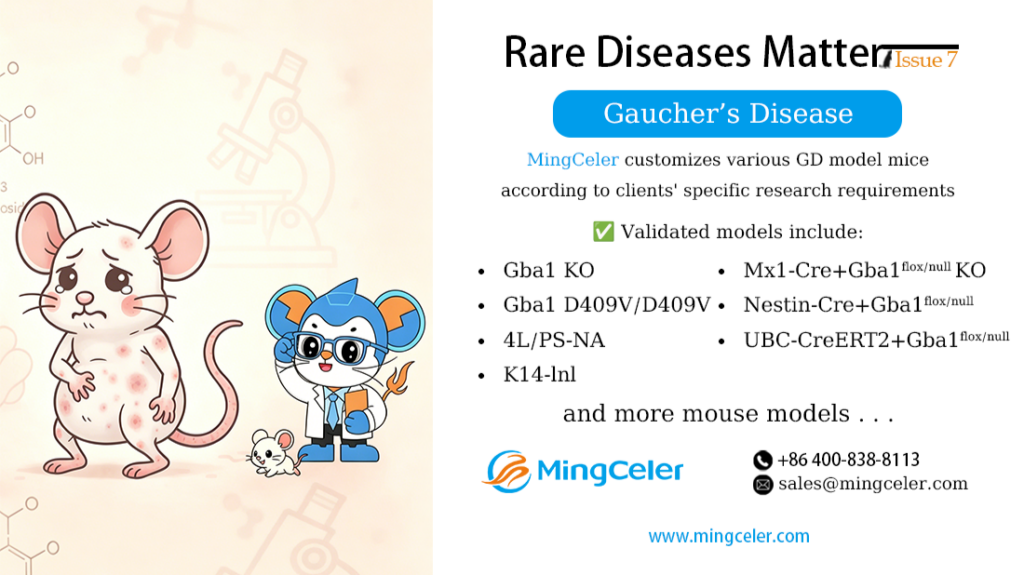
Gaucher’s disease (GD) is a rare autosomal recessive lysosomal storage disorder. The core cause is mutations in the glucocerebrosidase (GBA) gene, which drastically reduce or completely abolish enzyme activity. As a result, the substrate glucosylceramide (GlcCer) cannot be properly hydrolyzed and accumulates massively in lysosomes of the mononuclear–phagocyte system, forming characteristic Gaucher cells. These abnormal cells accumulate in organs such as the liver, spleen, and bone marrow, causing severe clinical manifestations.
Global epidemiological data report a standardized incidence at birth of 0.39–5.80 per 100,000 and a prevalence of 0.70–1.75 per 100,000, with substantial variation across ethnic groups and regions.
Based on neurological involvement and disease progression, GD is classified into three types: Type 1 (non-neuronopathic), Type 2 (acute neuronopathic), and Type 3 (chronic/subacute neuronopathic). Type 1 is the most common (>90%), presenting with hepatosplenomegaly, cytopenia, and bone disease without primary neurological symptoms. Type 2 is the rarest and most severe: onset within 1 year of life, rapid neurodegeneration, death typically by age 3. Type 3 manifests as progressive neurological impairment.
Pathogenesis
The fundamental mechanism is GBA1 gene mutations leading to GBA enzyme deficiency. Normally, GBA hydrolyzes glucosylceramide into glucose and ceramide. When GBA activity is reduced or absent, glucosylceramide accumulates in macrophage lysosomes, forming Gaucher cells. Massive accumulation in liver, spleen, and bone marrow causes organomegaly and dysfunction.

Recent research indicates that impaired GBA function also drives multi-organ injury via endoplasmic reticulum stress, mitochondrial dysfunction, and dysregulated autophagy. In the nervous system, α-synuclein aggregation is strongly linked to Parkinsonism in GD. In bone, osteoblast differentiation defects and osteoclast dysregulation underlie bone disease.

Gene Therapy
AAV-mediated gene therapy: Vectors such as AAV9 and AAVrh10 delivered intravenously or via CSF efficiently transduce liver and CNS. A 2019 study showed that intravenous AAV9-GBA significantly reduced visceral and cerebral GlcCer/Lyso-GL-1 levels in GD mice, improved neuroinflammation and neuronal injury, and enhanced motor/cognitive function.
Hematopoietic stem cell gene therapy: Patient-derived hematopoietic stem cells are engineered ex vivo with LV vectors to express functional GBA, then reinfused. Engineered cells engraft in bone marrow, differentiate into multiple blood cell lineages, and secrete active enzyme into circulation.
Mouse Models
- Gba1 KO mice: Severe neurodegeneration and visceral pathology; foundational model for mechanism studies.
- Gba1 D409V/D409V mice: Mimic partial GCase deficiency in human GD; prominent neuropathology with accumulation of glycosphingolipids (GlcCer, GlcSph) in brain.
- 4L/PS-NA mice: Gba1 V394L mutation + prosaposin knockout; severe neuropathy and motor impairment.
- Mx1-Cre+Gba1flox/null knockout mice: Visceral symptoms (splenomegaly, anemia, glycosphingolipid accumulation), no CNS involvement, normal lifespan; models non-neuronopathic GD (GD1).
- K14-Inl mice: Skin Gba1 expression preserved via K14 promoter; rapid neurodegeneration (death within 2 weeks); models GD2.
- Nestin-Cre+Gba1flox/flox mice: Neuron/glia-specific Gba1 knockout; motor dysfunction (gait abnormality, limb rigidity); microglial GCase activity preserved.
- UBC-CreERT2+Gba1flox/flox mice: Weight loss, motor dysfunction (gait abnormality, neck hyperextension), seizures; death within 7 days post-induction.
MingCeler Biotech Empowering Gene Therapy
Gene therapy brings hope to rare diseases, yet its development and validation depend critically on animal models. Leveraging our proprietary TurboMice™ Technology, MingCeler has developed multiple rare disease mouse models.
TurboMice™ overcomes bottlenecks of long lead times and low success rates for complex models, enabling editing at nearly any genomic locus. We can generate fully homozygous gene-edited mice directly from embryonic stem cells in as little as 2 months.
MingCeler provides customized Gaucher’s disease mouse models, including Gba1 KO, Gba1 D409V/D409V, 4L/PS-NA, Mx1-Cre+Gba1flox/null, K14-Inl, Nestin-Cre+Gba1flox/flox, and UBC-CreERT2+Gba1flox/flox mice. We welcome your inquiries.